

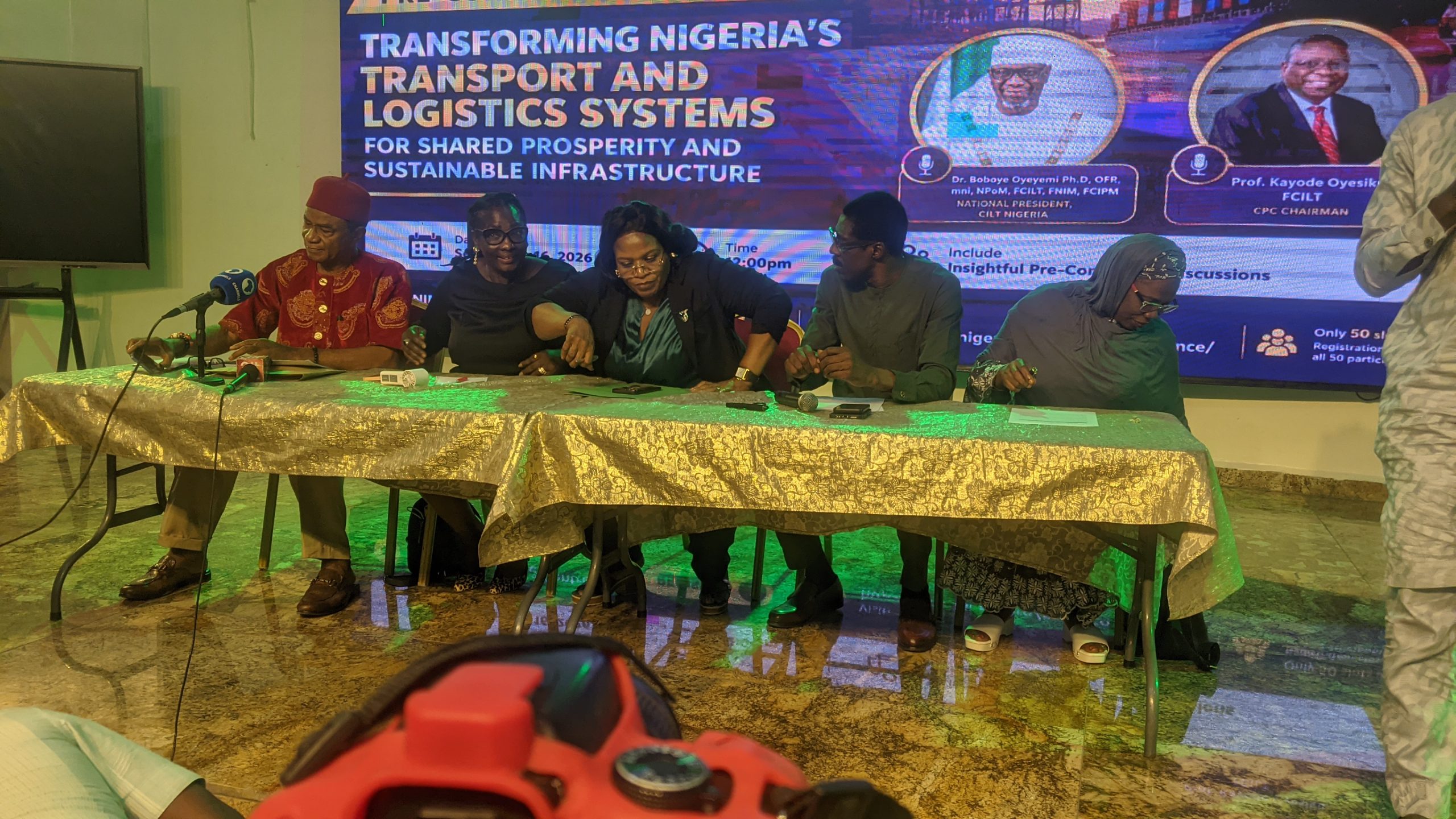
CILT Nigeria officials at the Pre-conference briefing
Nigeria’s economic recovery may depend heavily on what happens on the roads, railways, ports, waterways and logistics corridors that move people and goods across the country.
This is the emerging position of transport and logistics stakeholders who are converging in Abuja for the 2026 National Conference of the Chartered Institute of Logistics and Transport, CILT Nigeria, with a call to move beyond repeated discussions and focus on practical action.
The institute says transport and logistics should no longer be treated as an isolated sector because its performance directly affects almost every other part of the Nigerian economy.
From the farmer struggling to get fresh produce to market before it spoils, to the manufacturer paying more to move raw materials and finished products, the efficiency of the transport system can determine how much Nigerians ultimately pay for goods and how competitive local businesses can become.
CILT Nigeria made this position known at a pre-conference press briefing in Lagos ahead of its 2026 National Conference scheduled for October 21 to 23 at NICON Luxury Hotel, Abuja.
The conference, themed “Transforming Nigeria’s Transport and Logistics Systems for Shared Prosperity and Sustainable Infrastructure,” is expected to bring together policymakers, regulators, state governments, transport and logistics operators, investors, academics, technology providers, development partners and young professionals.
According to the institute, the objective is not to gather stakeholders merely to repeat the challenges that have confronted the sector for years, but to identify priorities, assign responsibilities and build partnerships capable of translating ideas into implementation.
CILT Nigeria argues that when the transport and logistics system is fragmented, unsafe, expensive or unreliable, the burden ultimately falls on households and businesses through higher costs, reduced productivity and limited access to markets.
But an efficient system, it says, can have the opposite effect by lowering the cost of moving goods and people, improving productivity, opening markets and creating better opportunities across communities.
The institute is therefore pushing for an integrated transport network in which road, rail, aviation, maritime transport, inland waterways, ports, terminals, logistics hubs and last-mile services complement one another rather than operate as disconnected systems.
The Abuja conference will examine sustainable and climate-resilient infrastructure, digital transformation and smart logistics, multimodal connectivity, governance and policy reform, infrastructure financing, human-capital development, professional excellence and inclusive mobility.
Professor Ayo Omotayo, Director-General of the National Institute for Policy and Strategic Studies, NIPSS, is expected to lead the keynote discourse, while Imo State Governor, Senator Hope Uzodimma, will serve as Special Guest of Honour.
The organisers say the expected participants include ministers and other policymakers, state governments, regulatory and infrastructure agencies, operators, captains of industry, academics, development partners, professional bodies, investors, students and young professionals.
For ordinary Nigerians, however, the real test of the conference will not be the number of speeches delivered, but whether the discussions can help make transportation safer, reduce the cost of moving food and other goods, improve access to jobs and markets, and make Nigerian businesses more competitive.
CILT Nigeria says the conference will end with a communiqué capturing priority recommendations and commitments arising from the discussions, reinforcing its stated intention to move the conversation from aspiration to action.
The message from the institute is direct: when transport and logistics work, Nigeria works.
The challenge now is turning that message into measurable changes that Nigerians can see and feel in their daily lives.
By Innocent Onoh
