
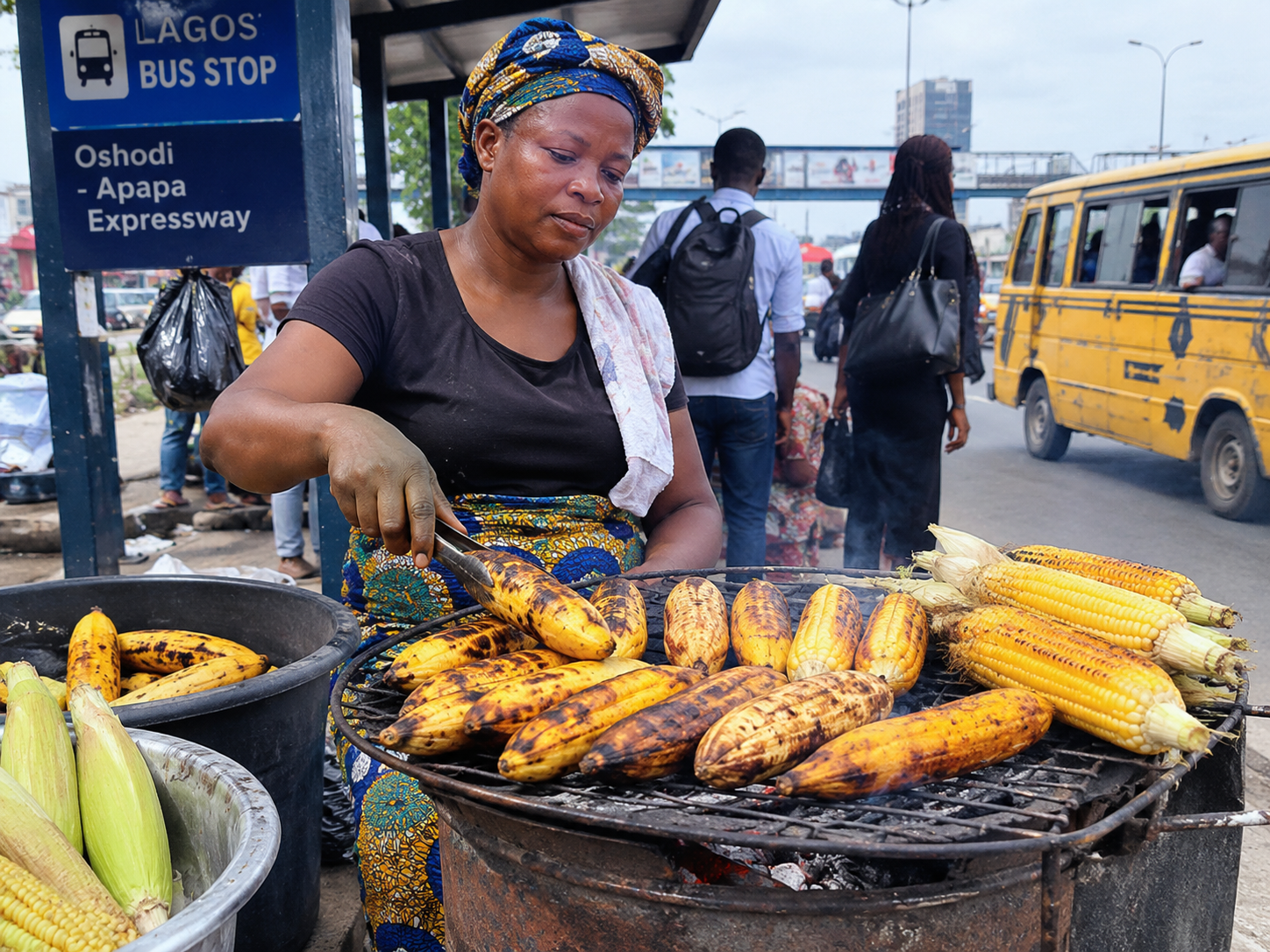

Lagos: Where Hard Work and Creativity Keep People Afloat Despite Joblessness
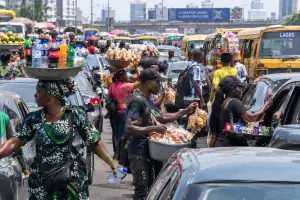
Hawkers take advantage of daily traffic experience in Lagos to make ends meet. They hawk snacks ,water , beverages and others
Unemployment remains one of Nigeria’s major socio-economic challenges, with thousands of young people graduating from universities and other institutions every year without corresponding job opportunities.
But in the midst of the job crisis, many Nigerians are refusing to give up.
From street vending and food preparation to domestic cleaning, transportation, waste collection and roadside trading, ordinary men and women are finding creative ways to survive and support their families.
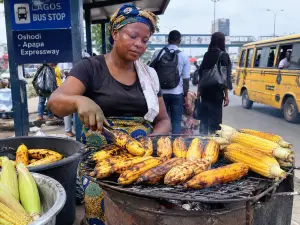
She roasts corn,plantain ,yam and sweet potatoes
In Lagos, Nigeria’s economic nerve centre and one of Africa’s most populous cities, these informal jobs have become a lifeline for thousands of residents.
For many, academic qualifications may not necessarily translate into employment. What matters is the willingness to work, the ability to identify an opportunity and the determination to make an honest living.
Lagos is a city where almost everything has a market, provided one is willing to work.
From food and farm produce to transportation, cleaning, tailoring, snacks production and domestic services, residents continue to explore different ways to earn a living.
For some low-income families, however, the struggle goes beyond finding work.
Accommodation is another major challenge.
In densely populated parts of the city, some families of six or more people live in a single room in houses popularly known as “face-me-I-face-you.”
For those without access to white-collar employment or formal education, menial jobs often provide the most realistic means of survival.
Sweeping compounds, educating children
Mrs Mercy Etim is one of them.
She does not clean offices or schools. Instead, she sweeps residential compounds and earns between ₦10,000 and ₦15,000 monthly from each compound.
She currently cleans about five compounds, with her children sometimes helping her.
Mrs Etim said she started the business about 15 years ago and that the income has helped her feed and educate her children.
“I started sweeping people’s compounds in 2011. I collect between ₦10,000 and ₦15,000 per month from a family.
“It is through this that I feed and train my children to university level. One is already a graduate, while the second is about to graduate.
“My advice to all women is to find something doing for the sake of our children. They are our future hope.”
She said the support she receives from some residents also helps her cope.
According to her, some occupants give her food and other gifts, particularly during festive periods.
Mrs Etim, who mainly works in residential compounds and public yards, explained that in some cases, tenants contribute money to engage cleaners.
She added that jobs involving additional services such as toilet washing usually attract higher payments.
Across Lagos, several women are engaged in similar domestic jobs, with some receiving assistance from their children.
Domestic cleaners filling a gap
Domestic cleaning is another growing informal occupation.
Some workers visit clients’ homes weekly to wash clothes, clean rooms and toilets, cook meals and perform other household chores.
With many Lagos residents increasingly reluctant to employ live-in domestic workers, these cleaners are gradually filling the gap.
There are also professional cleaning companies employing workers to clean private homes, offices, schools and other establishments.
Food business keeps families going
Food vending is another thriving informal business in Lagos.
While some vendors operate restaurants and small food outlets, others sell by the roadside, in markets, at bus stops or through hawking.
Akara, or bean cakes, is particularly popular.
Many akara sellers have expanded their businesses by adding fried yam, sweet potatoes, plantain, fish, chicken and puff-puff to their menus.
Others prepare and sell African delicacies such as abacha and ugba.
Local drinks, including zobo, tiger-nut drink, kunu and other beverages, are also providing income for many residents.
At a popular bus stop along the Oshodi-Apapa Expressway, food vendors sell different delicacies and snacks to commuters and workers.
For Monica, an abacha seller in Ajegunle, the business has become a means of keeping her family together.
“I sell abacha and it is helping me to train my children.”
Monica said she came to Lagos after marriage but was unable to secure formal employment.
Rather than remain idle, she turned to food vending.
From corn to whatever is available
There are also traders who specialise in seasonal farm produce.
Many operate from roadsides and walkways instead of formal shops, adjusting their businesses according to what is available in the market.
A housewife in Orile, who sells roasted corn, said the business helps her contribute to the upkeep of her family.
“I sell corn to assist my husband in providing for the family. I have been doing the business for over nine years.
“When corn is not available, I focus on other farm products that are available.”
She explained that her business changes with the seasons.
“When corn is not available, I roast plantain. If plantain is not available, I roast yam, then mango and other things, depending on what is available.”
For Rose, who operates around Maza-Maza, roasted yam and plantain have become profitable sources of income.
She sells both cooked and roasted yam, although she said customers prefer the roasted variety.
Because her stand is located at an intersection surrounded by several companies, she enjoys patronage from workers during their break periods.
“A lot of people like local food. Because of the large patronage, I had to employ one woman to assist me. I pay her ₦35,000 monthly.
“She was earning ₦25,000 in a private school but had to quit to work with me. Here, she is better off because, in addition to her salary, she gets free breakfast, lunch and dinner before going home.”
Hustling from morning till night
For many men in Lagos, transportation and street trading have become major sources of livelihood.
Some work as drivers for companies and schools, while others operate commercial buses, tricycles and motorcycles.
Young men also sell products such as rat poison, second-hand clothes popularly known as “okrika”, liquid soaps and household items.
Traffic trading is another common sight, with men and women moving between vehicles to sell bottled water, soft drinks, snacks and other goods.
Toochi, who came to Lagos in 2002 as an apprentice, said he had to reinvent himself after his master died before completing his apprenticeship.
“I came to Lagos in 2002 as an apprentice. Unfortunately, as I was about to finish the seven years of apprenticeship, my master died and there was nobody to settle me.
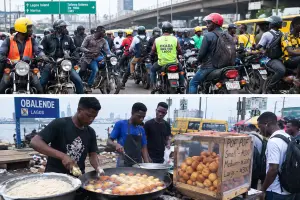
Top; Commercial motorcyclists popularly called okada Bottom: Akara and other snack fryers
“Since then, I have been hustling to become a man. I am into transportation and other businesses.
“Very early in the morning, I go to Lagos Island to sell clothes, and when day breaks, I go into transportation until night. I have no brother or sister to help me.
“I am succeeding gradually. At least, I have three children. With this hustling, I have a house and a plot of land.”
His advice to others struggling to survive is simple:
“People should not allow their problems to rule them. Rule your problem.”
Hawking in traffic
Tope, an indigene of Ondo State, sells bottled water and soft drinks around traffic.
She also operates a stand at a bus stop.
“I sell bottled water and soft drinks, hawking during traffic, but I also have a stand at the bus stop.
“If the market is good, I can make a profit of about ₦2,000. When there is no market, I make around ₦1,500.”
For some, however, traffic hawking has come with serious risks.
Aloysius from Ebonyi State said he hawked fried plantain on Lagos roads for about six years before quitting.
He came to Lagos to live with his brother, hoping to be sent to school, but realised that his brother was also struggling.
“I joined others in hawking on the highway, taking advantage of the traffic.
“But at a point, I had to quit after I saw a colleague knocked down and killed by a fast-moving vehicle. Another was hit and sustained serious injuries.”
The risks were not the only challenge.
He said government enforcement operations and alleged extortion by touts also contributed to his decision to leave street hawking.
After quitting, Aloysius learnt phone repair.
He started by repairing phones by the roadside before eventually renting a shop.
Today, he is married and has a son.
“From staying on the roadside repairing phones, I was able to rent a shop. Today, I am married and have a son.
“With God, all things are possible and hard work pays.”
A graduate frying puff-puff
Perhaps one of the more striking stories is that of Eze, a university graduate who now fries puff-puff for commuters in Lagos Island.
He lives in Ikotun but travels to Lagos Island daily to operate his business.
Unable to secure formal employment, Eze turned to food vending.
He admitted that he initially felt ashamed.
“At first, I was ashamed of it, especially because it was considered a business for females.
“But later, I saw that a lot of boys were into it and were making good money.”
He operates around a busy bus stop, taking advantage of early-morning commuters who need something to eat before getting to work.
The business eventually became too demanding for him to handle alone, so he employed two workers, paying each ₦30,000 monthly.
For more than five years, the business has sustained him.
“It is a good job. The problem we have now is the high cost of flour and extortion by touts who are all over Lagos.
“For more than five years, the business has sustained me. It is better than staying idle or going to steal.”
Dignity in labour
Across Lagos, there are many other forms of informal employment, including car washing, gardening, small-scale farming, waste collection, tailoring, repairs and various forms of street trading.
Interestingly, some people who started out in these jobs have been able to build houses, educate their children and improve their living conditions, both in Lagos and in their states of origin.
Their stories point to a broader reality: survival in Lagos does not always depend on a university degree or a white-collar job.
For many residents, resilience, creativity and a willingness to work have become their greatest assets.
There is, indeed, dignity in labour.
But while these informal workers are determined to make an honest living, many say their businesses are being threatened by rising costs, government levies and alleged multiple extortion by touts, popularly known as “agberos”, who they claim often present themselves as revenue collectors.
They are therefore calling on the Lagos State Government and relevant authorities to create a more supportive environment for informal businesses, protect legitimate traders from extortion and provide affordable spaces where small businesses can operate.
For the thousands of men and women who wake up every morning to hustle, their message is clear:
They may not have formal jobs, but they are working. They may not have academic qualifications, but they have skills. And above all, they are determined to survive with dignity.
Ebere Obike /Innocent Onoh
