

What started as a plan to build a refinery became something much bigger — a massive industrial ecosystem requiring its own jetty, power plant and supporting infrastructure before it could begin to operate.
Lagos State Governor Babajide Sanwo-Olu has described the Dangote Refinery as a powerful demonstration of what Africa can achieve when ambition is matched with the infrastructure needed to make large-scale industrial projects work.
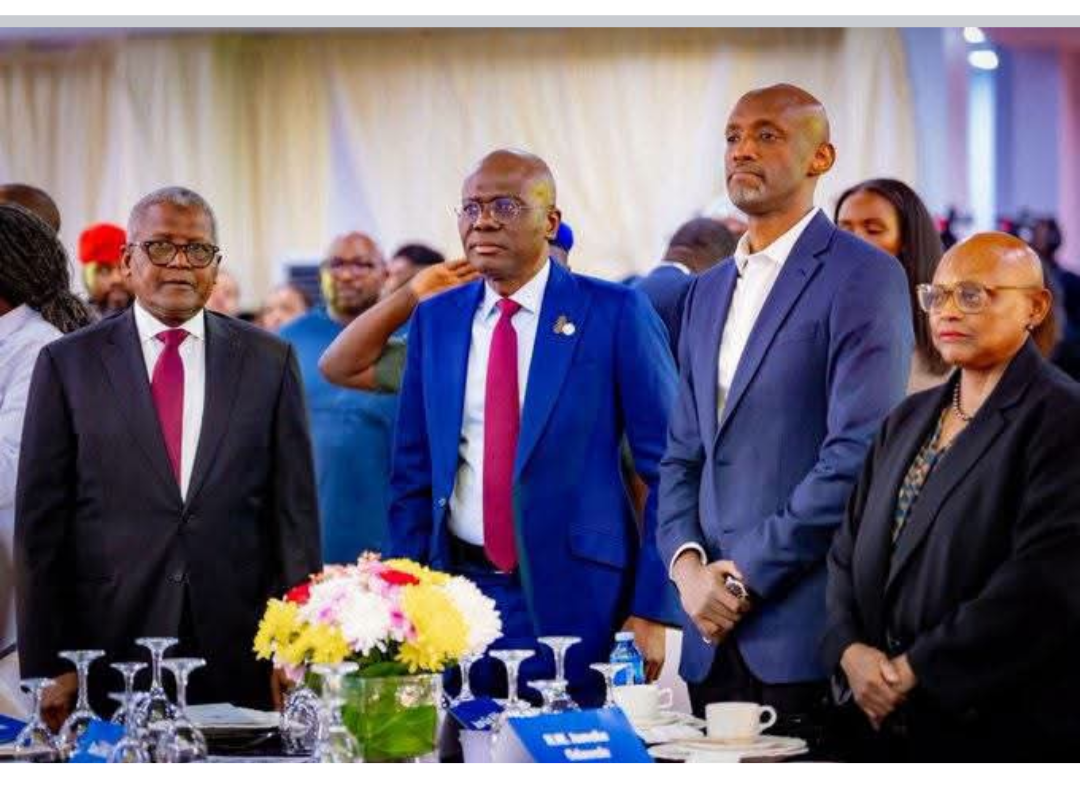
Sanwo-Olu spoke on Thursday at the official launch of the Africa–Diaspora Leadership Programme 2026 Young Global Leaders Convening, tagged “Building Africa at Scale,” held at the Dangote Refinery and Petrochemical Complex in Ibeju-Lekki, Lagos.
According to the governor, the project was constructed on land reclaimed from swamp, lagoon and open water, while the absence of adequate infrastructure meant additional facilities had to be created to support the refinery.
“Mr. Dangote did not build a refinery. He built a country around a refinery, and then he built the refinery,” Sanwo-Olu said.
He explained that because there was no port capable of receiving the equipment required for the project, a jetty had to be built, while inadequate power supply also necessitated the construction of a power plant.
The governor noted that the project faced major setbacks, including cost overruns, the COVID-19 pandemic and the sharp depreciation of the naira, amid doubts in some quarters about whether it would eventually become operational.
“But it runs,” he declared, describing the refinery as evidence that Africa can deliver projects capable of transforming markets.
Sanwo-Olu, however, warned that Africa cannot build its future around exceptional individuals repeatedly overcoming weak infrastructure and institutional barriers.
He described the Dangote experience as “heroism”, arguing that genuine development would be achieved when the next refinery, railway or major industrial project can be delivered without having to recreate an entire ecosystem from scratch.
“Scale that depends on one man building his own port and his own power plant is not real scale. It is heroism. And heroism does not repeat,” he said.
The governor pointed to the Lekki Deep Sea Port, Lekki Free Zone and Lagos Blue Line rail as part of efforts to create infrastructure that can reduce the cost and difficulty of future investments in Lagos.
He also called for greater participation by African pension funds, sovereign wealth funds and the African diaspora in owning strategic assets, arguing that the continent’s next phase of growth must be driven by collective investment rather than individual fortunes.
Addressing the young global leaders, Sanwo-Olu urged them to turn the relationships and ideas generated by the programme into practical projects capable of solving Africa’s real problems.
He drew a parallel between Lagos and New York, saying both cities demonstrate what determined people can build despite difficult starting conditions.
“Lagos and New York are not strangers. They are the same argument in two accents,” he said.
Sanwo-Olu challenged the young leaders to return to their respective communities with the conviction that Africa does not have to wait for perfect conditions or external permission before pursuing ambitious development.
He said Africa needs partners willing to invest in its future rather than outsiders approaching the continent merely in search of opportunities.
The governor’s message was ultimately less about one refinery than about what happens next: whether Africa can turn one extraordinary industrial achievement into a system where extraordinary projects become normal.
By Innocent Onoh
