
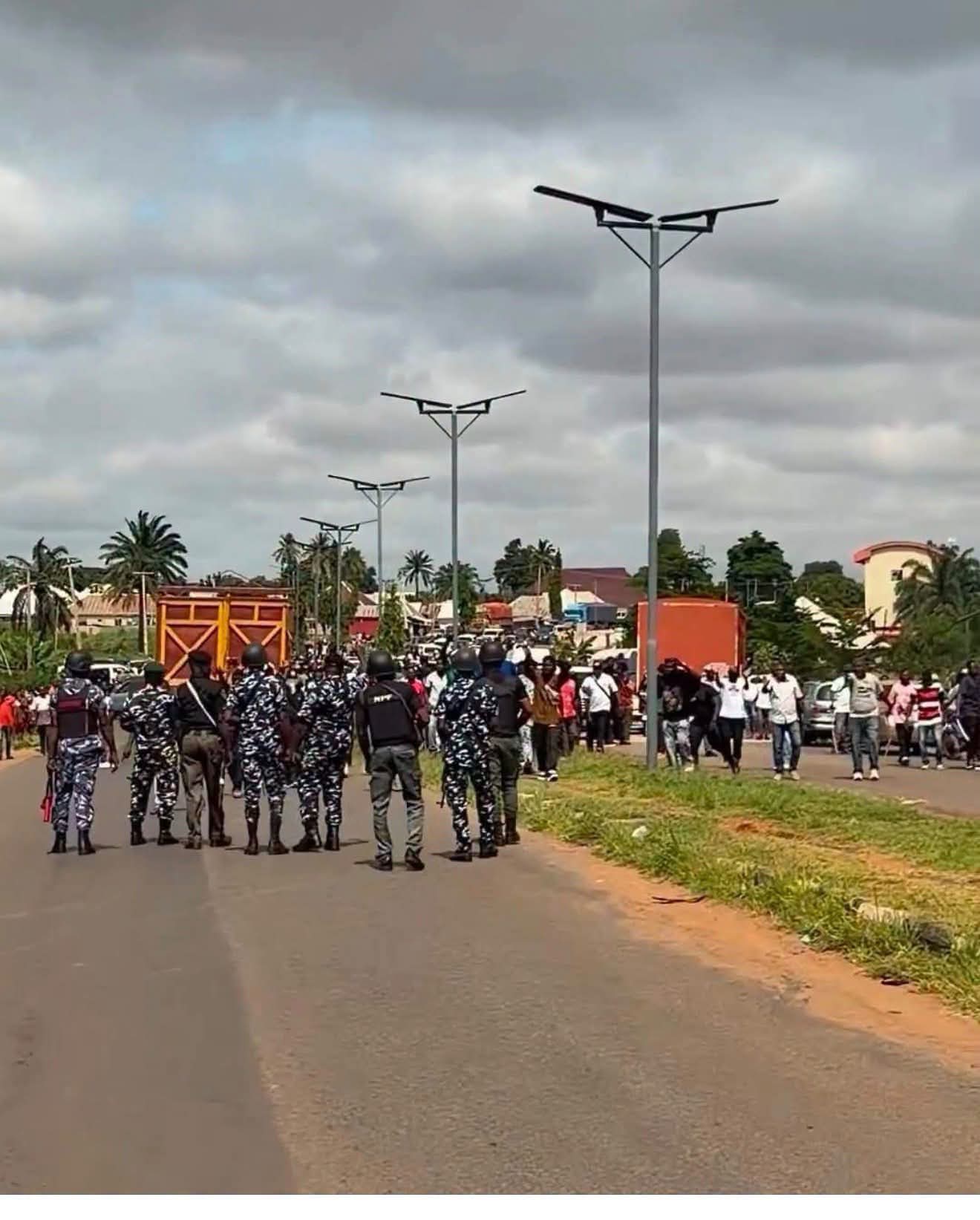

Peter Obi went to Benue for a simple reason: to stand with Nigerians who had lost loved ones in one of the country’s most painful recent tragedies.
But instead of reaching Yelwata to mourn with the victims’ families, his convoy was reportedly blocked.
Military personnel and alleged thugs enforcing the blocking of Obi
That development raises a much bigger question than the immediate confrontation in Benue: is Nigeria heading towards a repeat of the political controversies that surrounded the 2023 presidential election?
Obi has built a reputation for identifying with Nigerians facing hardship and tragedy. Whether one supports his politics or not, visiting communities devastated by violence is hardly an unreasonable activity for a presidential candidate.
The reported obstruction therefore deserves more than partisan exchanges. It demands answers.
Who ordered the blockage? Who were the people involved? Were they political supporters, security personnel, or both? And why should a presidential candidate be prevented from visiting Nigerians mourning the loss of their relatives?
These are questions the Benue State Government and security agencies should answer.
The political significance of Benue cannot also be ignored. The state has a substantial support base for Obi, yet he lost there in the 2023 presidential election. That result has remained controversial among some of his supporters, who believe the election did not reflect the candidate’s actual popularity in parts of the country.
Now, with another presidential contest approaching, the reported confrontation in Benue inevitably raises memories of 2023.
That is why President Bola Ahmed Tinubu must be particularly careful about the signals coming from his administration and political allies.
Tinubu has an opportunity to write a different chapter of Nigeria’s electoral history — one in which political competition is fierce, but the rules are respected; where opponents can campaign freely; and where no Nigerian is denied access to a community because of his political identity.
The President does not need to win every state to prove his political strength. He needs to demonstrate that the Nigerian people, not political machinery, will determine who wins the next election.
The allegations surrounding the Benue incident become even more troubling when placed alongside the wider political battles involving Obi and political figures who were once his opponents or allies.
But allegations of a coordinated effort to manipulate electoral outcomes must be backed by evidence. Nigeria has suffered enough from claims and counterclaims that deepen distrust without establishing the facts.
What is not in dispute, however, is the constitutional principle at stake: Nigerians should be free to travel, campaign, mourn and express political opinions peacefully.
That freedom cannot disappear simply because an election is approaching.
The reported blockage has already attracted condemnation from human rights voices, including Amnesty International, which described the development as a dangerous signal for Nigeria’s democratic process. That warning should not be dismissed as partisan politics.
There is another irony here.
If the intention was to diminish Obi’s presence in Benue, the incident may achieve the opposite. It has drawn even greater attention to Yelwata, to the victims of the violence and to the political tensions surrounding Obi’s visit.
Sometimes, attempting to silence a message only makes more people listen.
The Benue episode has also placed Governor Hyacinth Alia under increased public scrutiny. The Governor has a responsibility not merely as a politician but as the chief executive of a state still dealing with the devastating consequences of communal and terrorist violence.
His government must therefore be seen as protecting every citizen, regardless of political affiliation.
And for the Catholic priest who became a governor, the moral expectations are understandably high. Political competition should never become an excuse for intimidation, violence or the denial of basic freedoms. If allegations of official or partisan involvement in the obstruction are established, they would raise serious questions about the standards of leadership expected from the state government.
But let the facts speak.
Nigeria does not need another election defined by fear, intimidation and allegations of manipulation.
It needs an election in which Peter Obi can campaign, Tinubu can campaign, Atiku Abubakar or any other candidate can campaign — and Nigerians can freely decide who they want.
President Tinubu should therefore resist every temptation to allow political desperation to override democratic responsibility.
He should order a transparent investigation into the Benue incident and ensure that nobody — whether politician, supporter or security official — is above the law.
Because the real test of democracy is not whether the ruling party wins.
By an UKATA News writer
