
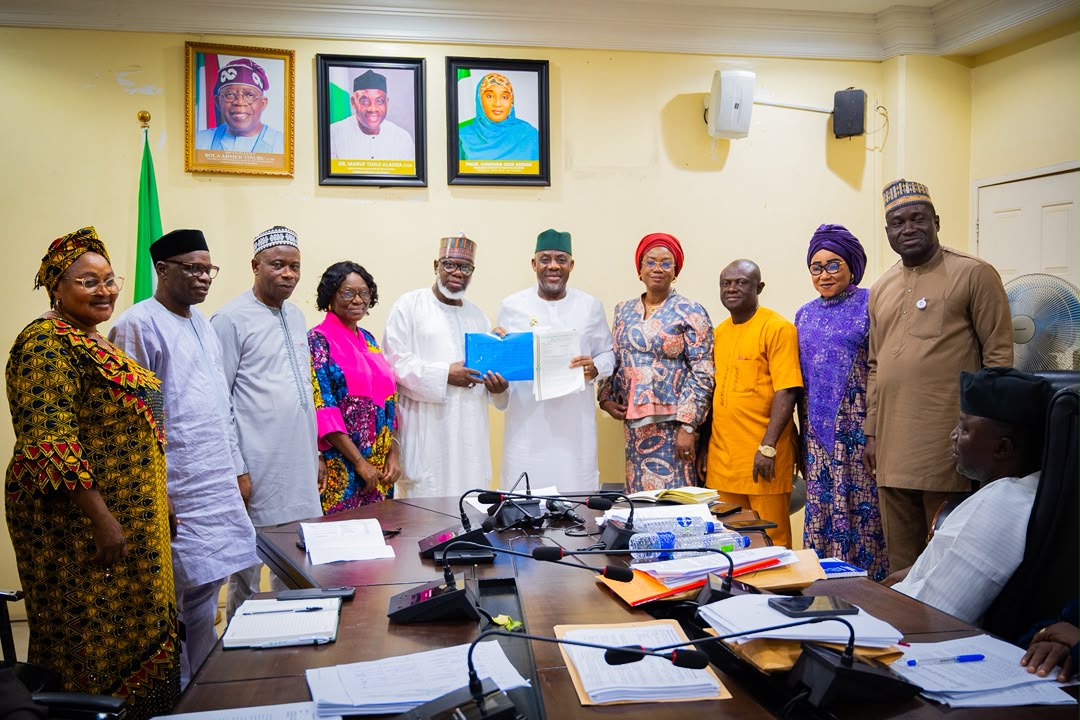

Minister of Education, Dr. Tunji Alausa, announced a 70 per cent minimum score for textbooks to qualify for the national ranking system, following the country’s first national assessment and ranking of instructional materials.
The Minister made the declaration in Abuja while receiving the assessment report and ranked list, describing the exercise as a major step towards improving the quality of learning materials available to Nigerian children.
Alausa said the assessment was part of the Federal Government’s broader quality assurance programme following the introduction of the revised national curriculum.
He explained that the Nigerian Educational Research and Development Council, NERDC, developed a standardised assessment toolkit based on international best practices to determine whether textbooks meet the requirements of the revised curriculum.
Curriculum alignment accounted for the largest component of the assessment at 51 per cent, while other areas covered language and style, instructional design, technical features, social and cultural compliance, and gender sensitivity.
The Minister said the 70 per cent benchmark was deliberately set to ensure that only textbooks meeting an acceptable quality standard make the national ranking.
He added that publishers whose books failed to meet the benchmark would not be permanently shut out, but would be expected to study the assessment results, correct identified deficiencies and resubmit their materials.
The assessment, however, exposed worrying gaps in the quality of some textbooks submitted for evaluation, with some scoring as low as 25 per cent.
Reacting to the findings, Alausa expressed concern over the quality of some instructional materials currently available to Nigerian pupils and students.
“Some of the books being used in our schools, primary schools, junior secondary schools and senior secondary schools are trash. Some of these books are scoring 25 per cent or lower. Is this the way our children should be educated?”
He insisted that such standards would not be allowed to continue under the present administration.
Alausa also urged Nigerian publishers to use the assessment as an opportunity to improve their materials, describing the process as corrective rather than punitive.
He commended publishers who participated in the exercise despite what he described as pressure and blackmail, adding, “I’m giving you the olive branch.”
The Minister said the national textbook assessment would be conducted in three cycles to cover all levels of the basic and senior secondary school curriculum.
The first cycle covers Primary One and Four, JSS One and SS One; the second covers Primary Two and Five, JSS Two and SS Two; while the third covers Primary Three and Six, JSS Three and SS Three.
Alausa further announced that the national curriculum would henceforth be reviewed every three years to keep it responsive to emerging educational, technological and societal needs.
Providing further details, the Executive Secretary of NERDC, Professor Salisu Shehu, said the assessment was conducted in line with the Council’s statutory responsibility to develop, review and promote quality educational materials for Nigeria’s education system.
Shehu said the exercise involved subject specialists, education experts and NERDC personnel working with approved assessment criteria and a defined scoring framework.
He explained that peer review was incorporated into the process to ensure that the outcome was not based on the judgment of a single official, but reflected documented professional assessments and collective expert evaluation.
According to him, textbooks scoring below the 70 per cent threshold would not qualify for the national ranked list.
The discovery of books scoring as low as 25 per cent, he added, reinforces the need for a transparent and evidence-based system for determining the quality of instructional materials used to educate Nigerian children.
