



For residents of Igando, switching on a light, fan or television after sunset has increasingly become less about waiting for electricity from the national grid and more about finding a personal source of power.Across parts of the Lagos community, solar panels are appearing on rooftops while rechargeable solar fans, inverters and small solar systems are becoming familiar household and business equipment.
For many residents, it is a practical response to years of unreliable electricity supply and the rising cost of running petrol-powered generators.
Igando, in the northwest of Lagos, has grown rapidly from a relatively quiet settlement into a densely populated community of homes, markets and businesses. But its growth has come with a familiar urban challenge — keeping the lights on.
Residents on Isuti Road in Egan-Igando and streets including Paul Oke, Falana, Shoga, Fatoki and Saudi say solar energy is increasingly providing an escape from the uncertainty of grid electricity.
For Mr. Dessy Chika and his family, the difference is particularly noticeable at night.
On one evening when much of the neighbourhood was without electricity, their home on Isuti Road remained brightly lit, powered by solar panels, batteries and an inverter.
Chika, who returned from Malaysia earlier this year, said he was surprised by the poor electricity supply he encountered after his return.
“When I came back from Malaysia this year, I was disappointed that power supply was so poor. Sometimes we stayed days without light. Later, they started giving us light one day on and one day off, often from 9 p.m. to 6 a.m. At that time, I was budgeting between ₦100,000 and ₦150,000 monthly for fueling the generator.”
With the cost of fuel making generator use increasingly difficult, Chika eventually invested about ₦2.5 million in a solar system capable of powering his household.
“When fuel became too expensive after subsidy removal, coping became difficult. Then a friend introduced me to renewable energy. I spent about ₦2.5 million to install solar equipment, enough to power everything in the house. It has been a blessing. The beauty is that there’s no noise like a generator. It is clean energy. The only challenge is that during cloudy days the panels don’t charge fully, so power may not last through the night.”
But solar adoption in Igando is not limited to households that can afford large installations.
Residents are increasingly buying systems according to their pockets — from complete home installations to smaller units capable of powering lights, fans, televisions and mobile phones.
For Mrs. Peace, a resident of Fatoki Street, the greatest benefit is the freedom from having to worry whenever electricity supply fails.
“The benefits outweigh those of NEPA. I use solar at home and in my office. I’m at peace whenever they take light, because the system switches on automatically without stress.”
Benjamin, who operates a food shop on Shoga Street, also relies on solar power for his business.
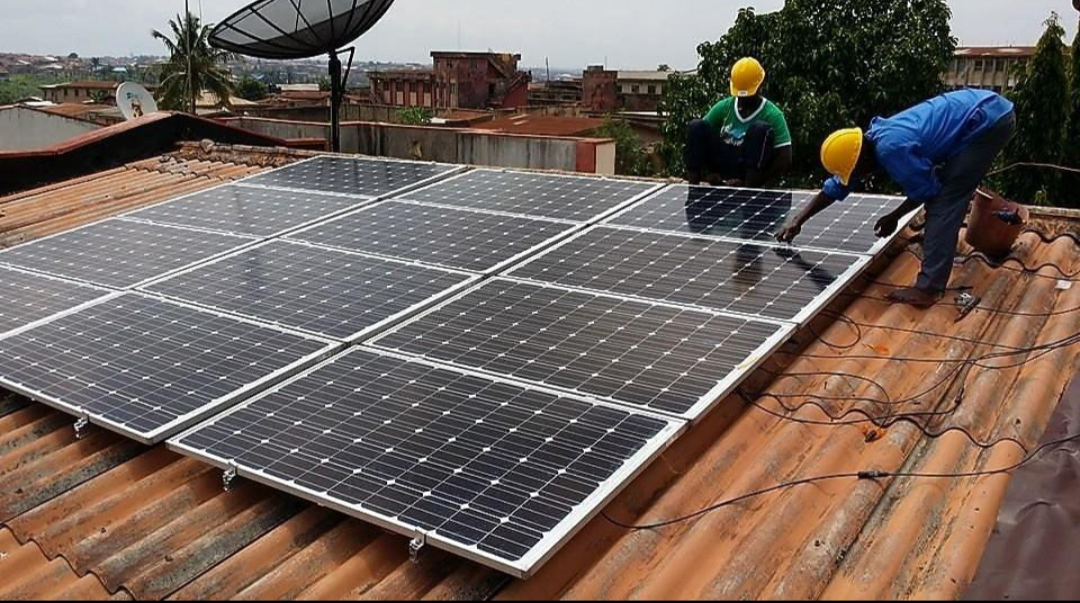
*Solar panels installed on a rooftop in Lagos. Across communities such as Igando, residents are increasingly turning to solar energy as an alternative to unreliable grid electricity.*
“It is very good and beneficial for both homes and businesses. Unlike the power company that brings crazy bills, solar is a one-time investment that serves you for many years without further payments.”
The growing demand has also created a small renewable-energy market within the community, with solar equipment vendors and installers springing up in Igando and neighbouring Ikotun. Some vendors are offering flexible payment arrangements to make the technology more accessible.
For Mrs. Paula Nweke, a pregnant resident, the solution did not require a multimillion-naira installation.
Her husband bought a rechargeable solar fan for ₦85,000, providing relief from the heat during periods of blackout.
“We even use the fan to charge phones. My neighbour’s fan also has light, so it cools, lights up the room, and charges phones at the same time. Since we bought ours, we no longer go to commercial phone charging centres, saving at least ₦500 daily. Many people here don’t even bother with PHCN again because they have solar at home. The poor go to those who have solar to charge their bulbs and power banks.”
The experience of Igando residents reflects a wider shift in Nigeria, where households and businesses are increasingly looking beyond the national grid for reliable electricity.
Data from the Nigerian Electricity Regulatory Commission (NERC) show that Nigeria’s grid-connected power plants had an installed capacity of 13,625 megawatts as of April 2026, but only an average of 4,286 megawatts was available for dispatch during the month. That translated into a plant availability factor of 31 per cent.
The country’s grid has also continued to experience system disturbances. NERC’s 2024 Annual Report recorded nine system-collapse incidents in 2024 — five partial and four total collapses.
NERC has acknowledged renewable energy as an important part of expanding Nigeria’s electricity supply, while the regulator has also been working on frameworks for integrating renewable and distributed energy resources into the electricity system.
Nigeria’s solar resource is substantial. The World Bank’s Global Solar Atlas provides country-level data on solar irradiation and photovoltaic potential, with solar-resource mapping available across Nigeria.
Energy consultant Jack Ekano believes the growing interest in solar could be accelerated if the cost of equipment is reduced and local manufacturing receives stronger support.
“We have the sunlight. What we lack is the political will and supportive policies. If duties on imported solar equipment are waived and local production encouraged, costs will fall and more people will adopt it.”
Economist Prof. Chris Onalo also links reliable electricity to wider economic opportunity, arguing that stable power — whether renewable, grid-based or a combination of sources — could help households and businesses become more productive.
“You can imagine if this country can generate 20,000 to 40,000 megawatts, which is the benchmark for its size. The man or woman in the village would create enough enterprise to be self-reliant. There would be mass economic empowerment because regular power drives economic activity.”
For Igando residents, however, the energy transition is less about statistics and more about everyday life.
It is about the trader who can keep a shop open after sunset, the family that can sleep with a fan running, the student who can study at night and the small business owner who no longer has to calculate how much fuel the generator will consume.
Chika puts the experience simply:
“We couldn’t wait for the government to fix the power problem. We fixed it ourselves.”
Igando’s growing solar market may therefore be more than a response to blackouts. It is a glimpse of how Nigerian households and businesses are adapting to an electricity system that has struggled to consistently meet their needs.
By Innocent Onoh
