
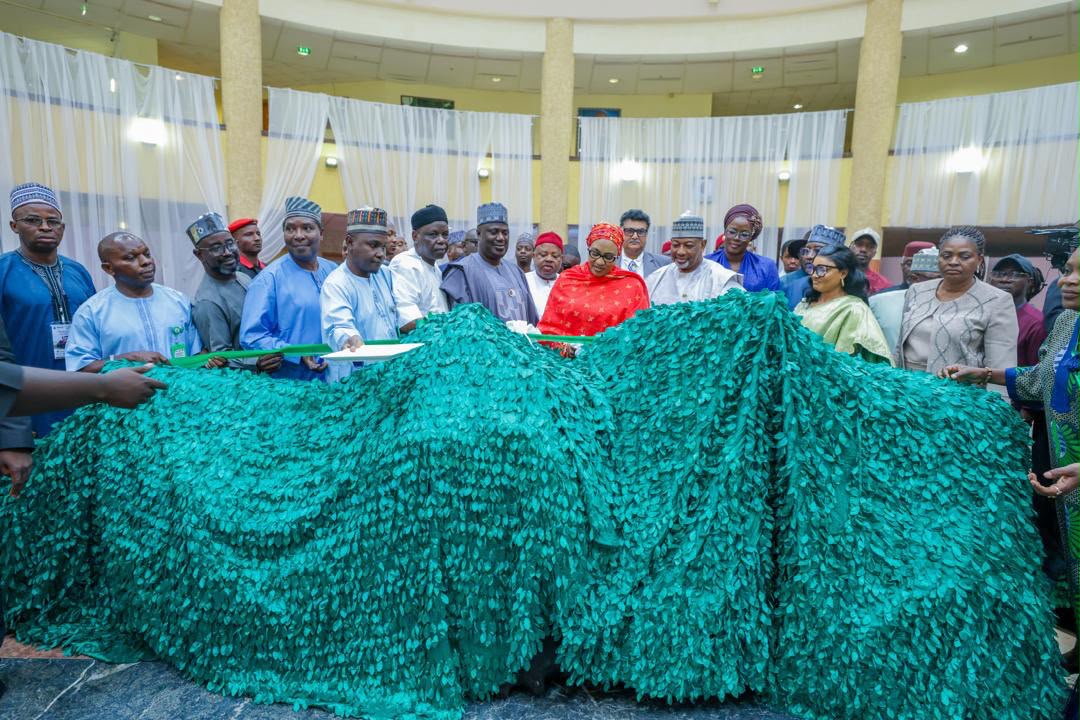



For 5,000 Nigerian women and young people, farming could soon mean more than hoes, cutlasses and back-breaking labour.
The Federal Government has unveiled the AGRI360 Mechanization Training Initiative, a programme designed to equip 5,000 women and youths across the country with practical skills in agricultural mechanisation, entrepreneurship and modern farming.
The initiative is aimed at helping participants turn agricultural skills into jobs and businesses while improving access to machinery and supporting year-round food production in communities across Nigeria.
Speaking at a National Colloquium in Abuja, First Lady Oluremi Tinubu, represented by Hajiya Nana Shettima, described agricultural mechanisation as a strategic investment that would make modern farming machinery more accessible and affordable to Nigerian farmers.
Minister of Agriculture and Food Security, Senator Abubakar Kyari, said the Federal Government was working towards a “Mechanization-as-a-Service” economy, where farmers could access machinery without necessarily owning expensive equipment.
According to Kyari, the model would not only reduce farmers’ dependence on physical labour but also create new jobs for tractor operators, technicians, machinery managers and agricultural service providers.
He said mechanisation would increase productivity and make agriculture more attractive to young Nigerians while opening up fresh opportunities across the agricultural value chain, particularly in rural communities.
Minister of State for Agriculture and Food Security, Senator Sabi Abdullahi, said AGRI360 would also tackle the gender gap in access to agricultural mechanisation.
He noted that women account for about 49 per cent of agricultural labour, yet many remain excluded from mechanisation opportunities and the income generated from modern agricultural services.
For Managing Director of Mela-Chiyoma Pat Limited, Mrs Patricia Stan-Dioka, the initiative is about moving beyond training certificates to creating actual livelihoods.
She said AGRI360 was designed to turn skills into jobs, businesses and enterprise opportunities throughout Nigeria’s agricultural mechanisation value chain.
Adding an international dimension to the programme, Captain Tractors India pledged to support nationwide tractor deployment and provide training for farmers, youths and mechanics.
The partnership is expected to strengthen the government’s drive towards modern agriculture, higher productivity and increased food production throughout the year.
For the thousands of women and youths targeted by the programme, the bigger promise is simple: less back-breaking farming, more machinery, more skills and a better chance to earn a living from agriculture.
