



Nigeria, IEA Seal Energy Partnership to Boost Investment, Security
For millions of Nigerians who spend more to cook, power businesses or keep their homes running, the search for affordable and reliable energy remains an everyday struggle.
The Federal Government says a new partnership with the International Energy Agency, IEA, could help Nigeria tackle some of these challenges by improving energy policy, attracting investment and strengthening the country’s energy security.
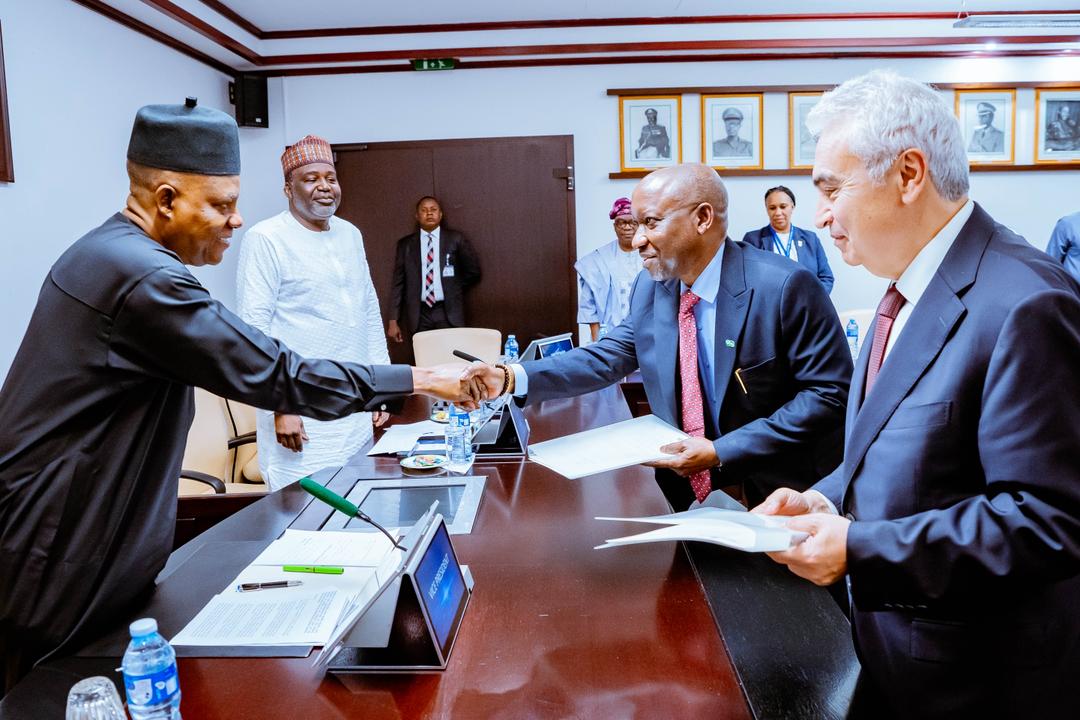
Nigeria and the IEA have signed a Joint Work Programme aimed at deepening cooperation in energy policy, investment, data development and security across the country’s energy value chain.
The agreement was signed in Abuja by Vice President Kashim Shettima and IEA Executive Director, Dr Fatih Birol.
Speaking at the signing ceremony, Shettima described Nigeria’s admission into the IEA as an Association Country as a significant milestone and a recognition of the country’s strategic importance in the global energy sector.
He said the development also reflected international confidence in the economic and energy reforms of President Bola Ahmed Tinubu’s administration.
According to the Vice President, Nigeria’s partnership with the IEA would provide access to international expertise, institutional knowledge and a global network that could help the country better harness its vast energy resources.
He reaffirmed the administration’s commitment to achieving energy security, affordability and sustainability, while ensuring that Nigeria’s transition to cleaner energy does not leave vulnerable communities behind.
For ordinary Nigerians, however, the real test of the partnership will be whether it eventually translates into cheaper and more reliable energy, better access to clean cooking and increased investment across the sector.
IEA Executive Director, Dr Fatih Birol, said Nigeria’s admission followed extensive consultations and the unanimous approval of the IEA Governing Board.
Birol said the agency would support Nigeria through policy advice, technical assistance and training for energy professionals.
The cooperation will cover several areas, including clean cooking, gas markets and emerging energy technologies.
The focus on clean cooking is particularly significant in a country where millions of households still depend on traditional cooking fuels, with consequences for household health, finances and the environment.
The Minister of State for Petroleum Resources, Gas, Ekperikpe Ekpo, said Nigeria’s admission into the IEA demonstrated the progress being made through the administration’s economic and energy reforms.
He said the Joint Work Programme would strengthen technical cooperation, particularly in developing reliable and accurate energy data to support sound policymaking and investment decisions.
For investors, better data could provide clearer information about opportunities and risks across Nigeria’s energy value chain. For government, it could improve planning and decision-making.
The Minister of State for Foreign Affairs, Ambassador Sola Enikanolaiye, described the partnership as strategically important to Nigeria, noting the role played by the Nigerian Mission in Paris in facilitating the country’s admission into the IEA.
Also speaking, the Director-General of the Energy Commission of Nigeria, Dr Mustapha Abdullahi, said the Commission already had an established working relationship with the IEA, including collaboration on Nigeria’s National Energy Master Plan.
He expressed optimism that the new Joint Work Programme would take the relationship to a higher level.
The partnership now places the focus on implementation.
For a country where energy challenges touch almost every household and business, Nigerians will be watching to see whether the new international cooperation can move beyond agreements and translate into more investment, cleaner cooking, better energy planning and, ultimately, more affordable and dependable energy for everyday life.
