
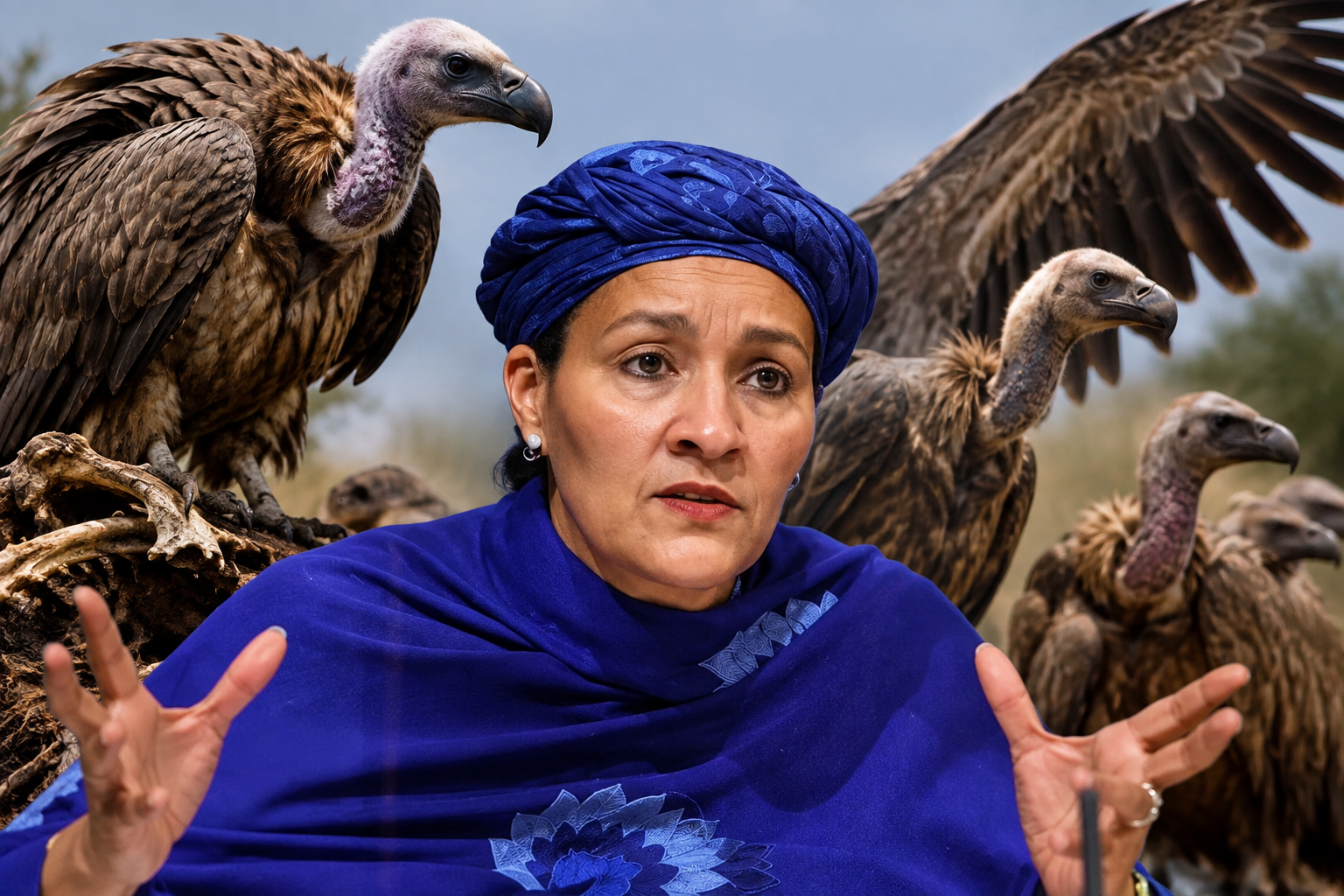



Raise Grassroots Awareness for Vulture Conservation — What Amina Mohammed Told Nigerians in 2017, and Why It Matters Today
Nine years ago, Nigerians were warned that the rapid decline of vultures could have serious consequences for human health, the environment and the economy.
Nine years on, that warning remains strikingly relevant.
Environmental experts have continued to advocate stronger conservation of vultures, describing the birds as “sanitation officers of the wild” because of their unique role in consuming carcasses and other decaying organic matter that could otherwise contaminate the environment and contribute to the spread of disease.
Vultures feed mainly on dead animals, helping to remove potentially infectious materials from the environment and reducing the risk of contamination of soil and water.
For Nigeria, where concerns about environmental degradation, biodiversity loss and infectious diseases remain significant, conservationists say the disappearance of these natural scavengers should not be viewed merely as a wildlife issue.
It is also a public health, environmental and economic concern.
A Warning From 2017
On January 19, 2017, then Minister of Environment Amina J. Mohammed delivered the 15th Chief S.L. Edu Memorial Lecture, organised by the Nigerian Conservation Foundation, NCF, in Lagos.
The lecture was held shortly before Mohammed assumed office as Deputy Secretary-General of the United Nations, a position she took up in February 2017. She is currently the UN Deputy Secretary-General and Chair of the United Nations Sustainable Development Group.
Her lecture, titled “Last Nigerian Vulture: The Consequences for Human Health and the Economy,” focused on the alarming decline of vultures in Nigeria and the implications for society.
“Vultures play a very crucial role in maintaining a healthy environment and the wellbeing of humans,” Mohammed stated.
She explained that vultures do not ordinarily hunt live prey but act as scavengers, feeding on the carcasses of dead animals.
According to her, the highly acidic nature of their stomachs enables them to digest decomposing carcasses carrying pathogens that could be dangerous to humans and other animals.
She noted that vultures can consume carcasses associated with diseases such as anthrax, cholera, botulinum toxin and rabies, helping to remove potentially dangerous material from the environment.
Mohammed also pointed out that vultures can serve as indicators of illegal wildlife activities because they are attracted to large carcasses, including those of elephants and rhinos killed by poachers.
Nature’s Clean-Up Crew
Beyond disease control, Mohammed highlighted the economic and ecological importance of vultures.
She described them as “Nature’s clean-up crew”, capable of removing large quantities of animal remains that would otherwise require human intervention.
“Given their huge range sizes and their dependence on high wildlife, vultures indicate ecosystem health,” she said.
According to Mohammed, vultures provide essential ecosystem services in both urban and natural environments and constitute one of nature’s most effective waste-disposal systems.
She cited an estimate that a single vulture provides a scavenging benefit worth about 11,600 US dollars annually, while avian scavengers are capable of removing thousands of tonnes of animal carcasses each year.
Without vultures efficiently removing decomposing meat, she warned, contamination of the air, soil and groundwater could increase.
Hence, she said, vultures could appropriately be regarded as the “sanitation officers” of nature.
A Species Disappearing From Nigeria’s Skies
Perhaps the most disturbing aspect of Mohammed’s 2017 presentation was the scale of the threat facing African vultures.
She noted that Africa had 11 species of vultures, with seven facing serious extinction threats. Four were classified as critically endangered, while another three were endangered.
Nigeria, she said, formerly had six known species — Egyptian, Hooded, African White-backed, White-headed, Rüppell’s Griffon and Palm-nut vultures.
Five of these species, she warned, were close to extinction in some parts of the country, while the species still surviving relatively well were also under pressure from habitat loss and indiscriminate hunting.
The threats included targeted poisoning, hunting for meat, habitat degradation, electrocution and collision with power infrastructure, as well as the use of vultures in traditional medicine and ritual practices.
From Common Sights to Rare Encounters
For older Nigerians, the decline is perhaps easiest to understand through memory.
There was a time when vultures could routinely be seen around abattoirs and places where animals were slaughtered.
After people had taken the meat they needed, the birds would gather to feed on the remains.
Today, that familiar sight has become increasingly rare.
For many young Nigerians, vultures are birds they know largely from television, books and the internet.
Some young people have never seen a vulture in real life.
That change is more than a disappearance from the skyline.
It represents the weakening of a natural ecological service that humans have benefited from for generations.
Awareness Begins With the Young
Mohammed placed considerable emphasis on awareness creation, particularly among children.
She called for awareness programmes in schools, stressing the importance of “catching them young” as part of efforts to improve the conservation status of vultures.
She also called for greater public understanding of the potential human-health consequences of the continued decline of African vultures and the enormous social and economic costs that could follow.
That recommendation has, in recent years, been reflected in a number of conservation initiatives in Nigeria.
The Nigerian Conservation Foundation has promoted environmental education through school conservation clubs and has increasingly involved children in its environmental programmes.
The foundation has also organised environmental summer boot camps aimed at teaching children about conservation and environmental responsibility.
The Lagos Waste Management Authority, LAWMA, has similarly engaged young people in environmental education, including initiatives that have seen schoolchildren trained and recognised as environmental champions.
The Federal Ministry of Environment has also continued to involve children in activities marking major environmental observances.
Taking the Message to the Streets
The campaign for vulture conservation has also moved beyond classrooms.
The NCF organised “A Mile for Egyptian Vultures,” an awareness initiative that brought together environmental enthusiasts and cyclists who rode through Lagos to draw public attention to the plight of vultures and their importance to human health and ecosystem stability.
The foundation has also provided technical support for conservation sites aimed at protecting vultures and their habitats.
These interventions are gradually helping to challenge an old perception of vultures as ugly or evil creatures associated with witchcraft and death.
But conservationists say one major challenge remains.
Traditional Medicine and the Vulture Trade
Vultures continue to be hunted and killed in some parts of Nigeria for use in traditional medicine and other cultural or spiritual practices.
This has remained a major concern for conservation stakeholders, who have repeatedly urged traditional medicine practitioners and other users of vultures to consider alternative materials, particularly plant-based substitutes.
The argument is simple: a bird that performs an important ecological service should not be pushed towards extinction for uses that may have alternatives.
Policy Must Match Awareness
For awareness campaigns to succeed, however, Mohammed argued that public education must be supported by effective policies, regulations and enforcement.
“Strengthening policy and regulatory instruments will also be important in preserving our vultures,” she said.
She called for stronger collaboration between government agencies, conservation organisations, researchers, private sector players and other stakeholders.
She also commended the existing collaboration between the Federal Ministry of Environment and the Nigerian Conservation Foundation.
“I would like to appreciate the existing collaboration between NCF and the Ministry and emphasise our resolve and intention to strengthen our collaboration as we forge ahead to pursue the conservation of our national natural resources with the aim of improving the quality of human life both in the present and the future,” Mohammed stated.
That call for collaboration remains relevant today.
A Message That Still Rings True
Nine years after Amina Mohammed raised the alarm, the question is whether Nigeria has done enough to protect the birds that quietly perform one of nature’s most important sanitation functions.
For conservation advocates, much more still needs to be done.
As concerns about environmental pollution, biodiversity loss, habitat degradation and infectious diseases continue, the disappearance of vultures should be treated as an environmental warning sign.
Protecting them will require more than occasional awareness campaigns.
It will require stronger enforcement against illegal hunting and poisoning, protection of their habitats, sustained public education, engagement with traditional medicine practitioners, scientific research and stronger collaboration between government and conservation organisations.
Most importantly, Nigerians need to understand that vultures are not creatures to be feared or despised.
They are part of the natural system that helps keep the environment cleaner and healthier.
And perhaps that is why a warning delivered by a Nigerian environmental minister in Lagos in 2017 — who would shortly afterwards become one of the United Nations’ highest-ranking officials — still deserves to be heard today.
If Nigeria can successfully change the perception of vultures, protect their habitats and stop the indiscriminate killing of the birds, future generations may once again see vultures filling the skies and gathering around abattoirs — not as symbols of death, but as nature’s own sanitation workers helping to protect life.
#UnitedNationsVulturesConservation #ChiefSLEduLecture #NigerianConservationFoundation #AminaMohammed #EgyptianVultures #VulturesConservation
By Innocent Onoh
