



Tinubu: Nigeria Will Become Africa’s Industrial Hub soon
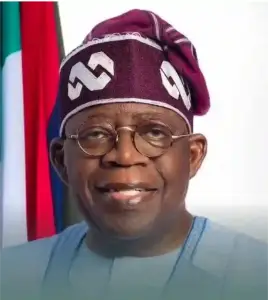
President Bola Ahmed Tinubu has declared that Nigeria is on course to become Africa’s industrial hub, assuring manufacturers that his administration will end the longstanding practice of exporting raw materials and importing finished products at high cost.
The President gave the assurance in Lagos while delivering the keynote address at the 6th Adeola Odutola Lecture, organised by the Manufacturers Association of Nigeria (MAN).
The lecture, which attracted senior government officials, industrialists, diplomats, academics and other stakeholders from Nigeria and abroad, had as its theme: “Leveraging National Industrial Policy to Position Nigeria as Africa’s Industrial Hub.”
Represented by the Minister of State for Industry, Senator John Enoh, Tinubu acknowledged the difficulties confronting manufacturers but maintained that the challenges were gradually being addressed through measures contained in the National Industrial Policy.
He said the policy was designed to remove critical bottlenecks affecting manufacturing and create an environment capable of supporting investment, production, value addition and exports.
According to him, the bold economic measures taken by his administration, though painful, were beginning to produce results, with economic conditions gradually stabilising.
The President said the Federal Government would implement the industrial policy in collaboration with the organised private sector, particularly MAN, with the objective of transforming Nigeria into a major manufacturing centre capable of producing for the domestic market and exporting across Africa.
He stressed that government could not industrialise Nigeria without the active participation of manufacturers.
Tinubu identified energy, access to capital, markets, security and accountability as critical pillars of the government’s engagement with the manufacturing sector.
On energy, he pledged continued priority for gas allocation to industries and reliable electricity for industrial clusters, noting that the cost of energy has a direct impact on the cost of production.
He also said government would work with the Bank of Industry, development finance institutions and the banking system to provide patient and affordable long-term financing for productive enterprises.
The President further announced that the government would strengthen the Nigerian First policy to ensure that public procurement favours locally manufactured goods that meet required standards.
He said trade facilitation measures, including the National Single Window, would reduce the time and cost of moving goods through Nigeria’s ports and borders.
Tinubu also promised improved security along industrial corridors, highways and supply routes to guarantee the smooth movement of raw materials and finished products.
On accountability, he said implementation of the National Industrial Policy would be monitored and publicly reported.
He disclosed that he had directed the Ministry of Industry, Trade and Investment, through the Industrial Renaissance Working Group, to hold quarterly delivery dialogues with MAN, allowing manufacturers to assess progress and hold government accountable.
The President urged manufacturers to expand productive capacity, deepen backward integration and source more raw materials locally from Nigerian farms and mines.
He also challenged them to see the African market as an extension of their domestic market and to position Nigerian businesses to compete across the continent.
Tinubu paid tribute to the late Chief Adeola Odutola, after whom the lecture was named, describing him as a pioneer who believed that Nigerians could build, own and manage great industries.
He said the present generation must build on the foundation laid by pioneers of Nigerian industry.
“History does not remember nations for what they dug out of the ground. It remembers them for what they made of it.
“For too long, we exported our cocoa and imported our chocolate. We exported our crude and imported fuel. We exported our cotton and imported our clothes. That chapter is closing, and very fast.
“We are writing a new one, and we are writing it in factories.”
The President expressed optimism that Nigeria would become the manufacturing workshop of Africa, producing goods for the continent and beyond.
Earlier, the outgoing President of MAN, Otunba Francis Meshioye, acknowledged the Federal Government’s efforts towards repositioning the industrial sector, particularly the development of the National Industrial Policy.
Meshioye described the policy as potentially far-reaching for the manufacturing sector but urged government not to stop at policy formulation.
He called for the immediate and holistic implementation of the policy, with manufacturers and other critical stakeholders fully involved in the process.
The outgoing MAN president identified high energy costs, inadequate electricity supply, poor infrastructure, skills gaps, multiple taxation and insecurity among the major challenges undermining manufacturing in Nigeria.
He also called for a system that would ensure the ready availability of gas to manufacturers, stressing that affordable and reliable energy remained essential to industrial competitiveness.
Meshioye said sustained collaboration between government and the organised private sector would be required to translate the new industrial policy into tangible improvements in the manufacturing sector.
The Guest Lecturer, former Director-General of the United Nations Industrial Development Organization (UNIDO), Dr Kandeh Yumkella, called for energy, agriculture, climate change and youth capacity development to be integrated into Nigeria’s industrialisation strategy.
Yumkella described Nigeria as the “king” of Africa and said the country had the scale, resources, entrepreneurial energy and strategic location required to become a major industrial power.
He, however, cautioned that potential alone was not enough, stressing that Nigeria must convert its enormous resources and entrepreneurial capacity into productivity, competitiveness, value addition and exports.
The former UNIDO chief said countries did not industrialise simply by producing policy documents but by translating policies into productive capacity, investment, technology and job creation.
He said Nigeria must learn from countries that deliberately supported industrial development and must develop policies capable of responding to changing global supply chains, artificial intelligence, climate change, energy transition and geopolitical competition.
Yumkella recalled his experience visiting textile factories in Kaduna, where production was repeatedly disrupted by power outages, describing the experience as evidence of why energy policy must be an integral part of industrial policy.
He said Nigeria could no longer afford to ignore the opportunities presented by emerging industries, particularly pharmaceuticals, automobiles, renewable energy, critical minerals and battery production.
On lithium, Yumkella said Africa possessed a substantial share of the critical minerals required for the global energy transition, describing lithium as the “new white gold” because of its growing importance in battery production.
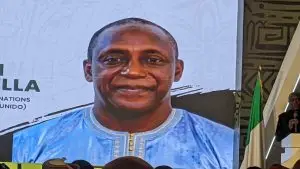
Guest lecturer
He urged Nigeria to move beyond exporting lithium and other minerals in raw form and instead promote local processing and value addition.
According to him, Nigeria could become a regional battery manufacturing hub if it combines its mineral resources with appropriate industrial, energy and investment policies.
He also identified opportunities in electric motorcycles, buses, batteries, charging infrastructure and other components of the automotive value chain.
Yumkella stressed that Nigeria’s industrial ambition should extend beyond its domestic market to West Africa, the wider African continent and the global market.
He cited Aba and Nnewi as examples of Nigeria’s entrepreneurial capacity, recalling the innovative activities of small and medium-sized manufacturers in the two industrial clusters.
He said government should provide such businesses with the infrastructure, technology, finance, standards and market access required to scale up and compete internationally.
The lecture also featured goodwill messages from prominent public and private-sector stakeholders in manufacturing, while awards were presented to distinguished personalities for their contributions to the sector.
The Guest Lecturer, Dr Kandeh Yumkella, was among those honoured.
The event ended with a vote of thanks by the Director-General of MAN, after which participants attended a presidential luncheon.
By Innocent Onoh
