



Solar Power Can Cut Food Losses, Create Jobs, Improve Lives — Presidency
For millions of Nigerians who struggle daily with unreliable electricity, expensive generators and farmers who watch portions of their harvests rot for lack of storage, solar energy could offer more than just light — it could provide a pathway out of poverty.
The Senior Special Assistant to the President on Climate Technology and Operations, Hon. Prof. Olamide Fagbuji, has identified renewable energy as a major tool for tackling Nigeria’s energy poverty, strengthening food security and creating jobs.
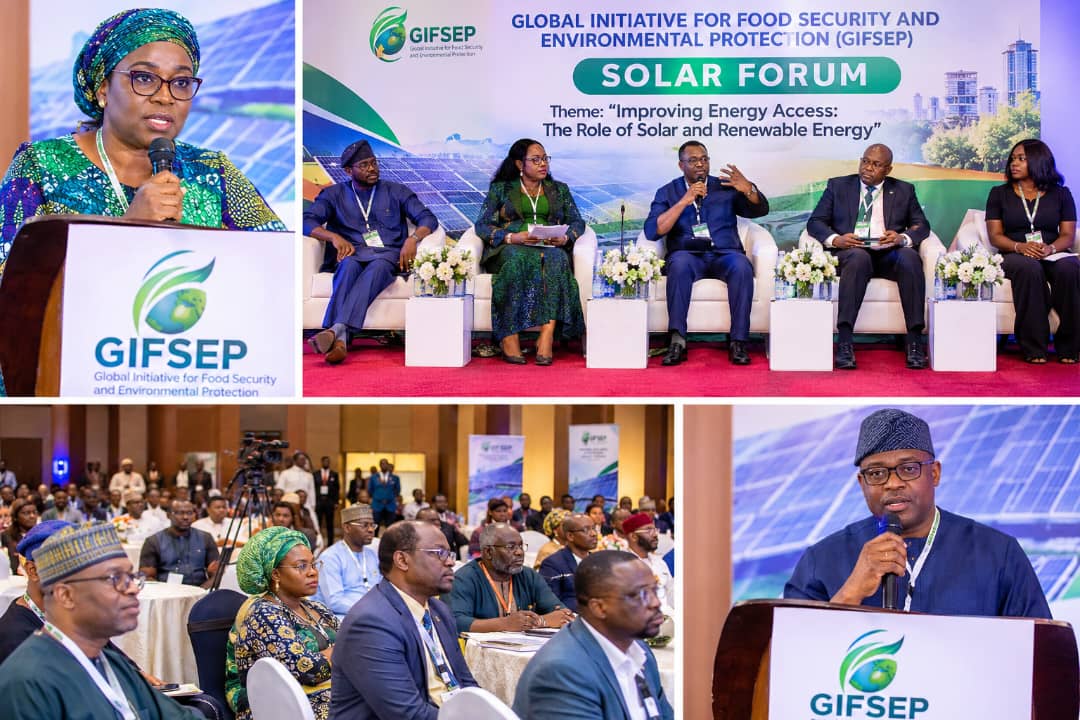
Fagbuji made the submission at the Global Initiative for Food Security and Environmental Protection (GIFSEP) Solar Forum in Lagos, with the theme, “Improving Energy Access: The Role of Solar and Renewable Energy.”
He noted that nearly half of Nigerians still lack access to reliable electricity, leaving millions of households and businesses dependent on costly diesel generators.
“This energy deficit constrains productivity, discourages investment, limits educational opportunities, weakens healthcare delivery and increases the cost of doing business,” Fagbuji declared.
He, however, maintained that Nigeria’s energy transition must be viewed beyond the environment, stressing that it should directly improve the lives and livelihoods of citizens.
“Our foremost challenge is to eradicate energy poverty while simultaneously pursuing sustainable economic growth,” he added.
The impact is particularly severe in the agricultural sector, where lack of electricity for irrigation, refrigeration, processing and storage contributes significantly to food losses.
According to Fagbuji, Nigeria loses an estimated 30 to 40 million metric tonnes of food annually to post-harvest losses, with the economic value put at between three-and-a-half and five trillion naira every year.
“A nation cannot sustainably feed its population without reliable energy,” he stressed.
He identified solar-powered irrigation systems, cold rooms and renewable-powered agro-processing centres as practical solutions capable of helping farmers preserve their produce, add value and increase their incomes.
Fagbuji also drew attention to the burden carried by households that depend on firewood and charcoal for cooking.
Approximately 70 to 80 per cent of Nigerian households still depend primarily on traditional biomass for cooking, exposing millions of women and children to household air pollution.
The consequences, he noted, include respiratory and cardiovascular illnesses and premature deaths.
Nigeria, according to him, has the natural advantage to change this narrative, with solar irradiation averaging between five and seven kilowatt-hours per square metre per day across much of the country.
“The question before us is therefore no longer whether renewable energy is technically feasible.
The question is how quickly we can mobilise the right policies, investments, institutions and partnerships to translate this enormous potential into tangible improvements in the lives of ordinary Nigerians,” Fagbuji maintained.
He highlighted the Electricity Act 2023 as one of the major reforms opening up the sector to decentralised electricity markets, private investment and distributed renewable energy systems.
The Nigeria Electrification Project and the Distributed Access through Renewable Energy Scale-up Programme, he disclosed, have collectively unlocked more than 1.3 billion dollars in investment commitments for distributed renewable energy.
While the Nigeria Electrification Project has impacted 7.8 million Nigerians, the DARES programme targets 465 megawatts of electricity, 3.24 million households, 236,986 MSMEs and 17.5 million Nigerians.
Beyond expanding electricity access, Fagbuji urged Nigeria to develop the capacity to manufacture solar panels, batteries, inverters and other renewable-energy technologies locally.
“Renewable energy is one of Nigeria’s greatest industrial opportunities,” he declared, urging the country to become a producer, assembler and exporter rather than merely a consumer of clean-energy technologies.
He also advocated greater investment in technical education, apprenticeships, research and innovation to equip young Nigerians with the skills required for the emerging green economy.
On the growing challenge of discarded solar panels and batteries, Fagbuji called for the development of recycling and materials-recovery industries.
He noted that recovering critical minerals such as lithium, cobalt and copper could reduce environmental risks while creating thousands of skilled jobs.
As Nigeria pursues its energy transition, the presidential aide called for stronger collaboration among government, industry, academia, development partners and civil society.
“Government must provide enabling policies, industry must drive investment and innovation, while universities and research institutions develop the technologies and skilled workforce needed for a competitive clean energy economy,” he urged.
Fagbuji expressed optimism that the transition to cleaner energy could ultimately deliver more than electricity, describing it as an opportunity to “create jobs, strengthen food security, accelerate industrialisation, enhance environmental stewardship and build a resilient, technology-driven economy.”
