
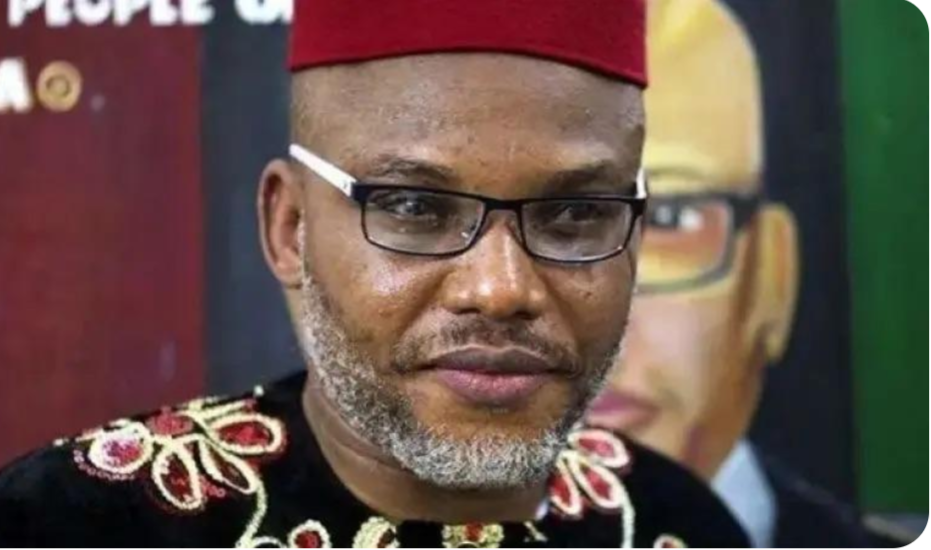



Nnamdi Kanu: As Election Politics Intensifies, Some Youths Ask, ‘Who Is Speaking for Him?’
As political activities and election-related campaigns gather momentum across Nigeria, a question is increasingly surfacing in social media conversations: what has happened to the agitation for the release of Nnamdi Kanu?
Nearly a year after Kanu was sentenced to life imprisonment and transferred to the Sokoto Correctional Facility, some youths expressing views online are questioning whether political competition and electioneering have pushed his case further down the national conversation.
Their concern is particularly directed at political leaders and influential figures from the South-east, with some asking why more attention appears to be focused on elections, campaigns and political alliances while Kanu remains incarcerated.
Kanu, leader of the proscribed Indigenous People of Biafra, IPOB, was convicted by the Federal High Court in Abuja on November 20, 2025, after Justice James Omotosho found him guilty on seven counts relating to terrorism and other offences.
He was sentenced to life imprisonment on some of the counts, alongside additional prison terms.
Following the judgment, Kanu was taken to the Sokoto Correctional Facility. A subsequent application seeking his transfer from Sokoto to a facility closer to Abuja was struck out by the Federal High Court in January 2026.
Kanu has consistently denied the allegations against him, while his legal team has challenged his conviction.
In February 2026, an appeal was filed at the Court of Appeal seeking to overturn the conviction and sentence and secure his acquittal.
It is against this background that some youths online are asking whether Igbo political leaders and elders should be doing more to keep Kanu’s case in the national political conversation.
Some of those expressing the view argue that political leaders could have used their influence and negotiations with the Federal Government to push for Kanu’s release or a political resolution to his case.
They describe Kanu as a freedom campaigner whose objective, in their view, was to pursue self-determination for the people of Biafra. That position, however, differs sharply from the findings of the Federal High Court, which convicted him on terrorism-related charges.
For others, the issue goes beyond Kanu personally. They see his continued imprisonment as part of a wider unresolved question about self-determination, federalism, political inclusion and the relationship between the South-east and the Nigerian state.
Some youths have also drawn comparisons with independence movements in other parts of the world, arguing that demands for greater autonomy or independence have, in some cases, been pursued through political negotiations.
However, claims circulating online that the United Kingdom has begun formal negotiations to divide the country into three independent nations do not accurately describe the current situation. Recent developments in Britain have involved increased support for independence or greater autonomy in Scotland, Wales and Northern Ireland, but this does not amount to an ongoing formal process to break the UK into three independent countries.
Kanu’s case also remains a matter before the courts rather than a settled political question. His appeal means that the judicial process has continued beyond the November 2025 conviction and sentencing.
The debate therefore presents a difficult question for political leaders in the South-east: how should they balance participation in Nigeria’s electoral politics with continued advocacy on an issue that remains emotionally significant to many people in the region?
For the youths raising the question online, the concern is not necessarily about abandoning electoral politics. Rather, they want to know whether the growing attention to elections has diminished the urgency of the campaign for Kanu’s legal and political future.
As campaigns, alliances and political calculations continue ahead of the next election cycle, Kanu’s supporters and critics alike will be watching whether his case remains a major issue in South-east political discourse—or gradually becomes overshadowed by the contest for political power.
By Innocent Onoh
#NnamdiKanu #IPOB #Biafra #SouthEastNigeria #IgboYouth #SelfDetermination #PoliticalDialogue #NigeriaPolitics #Election2027 #SoutheastPolitics #HumanRights #RuleOfLaw #NnamdiKanuAppeal #SokotoCorrectionalCentre #UKATANews
