
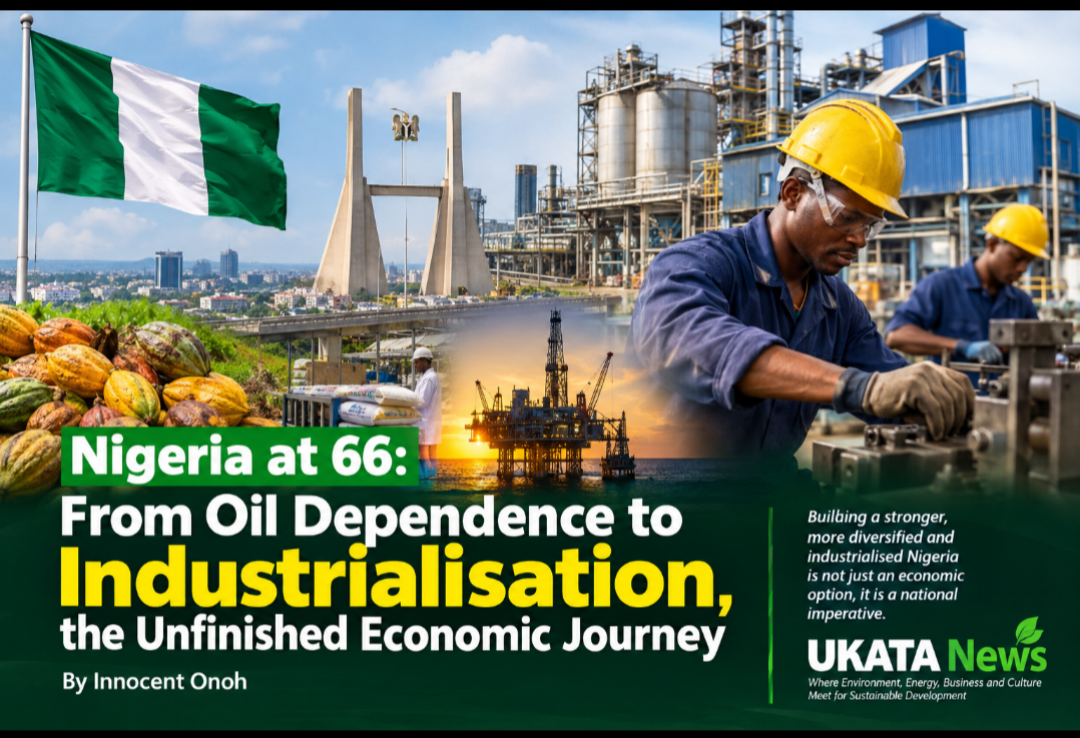



Nigeria at 66: From Oil Dependence to Industrialisation, the Unfinished Economic Journey
Sixty-six years after independence, Nigeria is still grappling with a fundamental economic challenge: transforming its abundant natural resources into industrial wealth, sustainable jobs and improved living standards for its citizens.
From an agricultural economy that once supported thriving export industries to the discovery of oil and successive economic reforms, Nigeria has recorded significant milestones. However, its ambition to become a major manufacturing hub remains largely unrealised.
As the country reflects on its economic journey, questions persist over the opportunities lost, the structural challenges holding back industrial growth and the policy choices required to build a productive, competitive and diversified economy.
From Agricultural Strength to Oil Dependence
When Nigeria gained independence in 1960, agriculture was the backbone of its economy, providing employment, foreign exchange and raw materials for emerging industries.
The country was a major exporter of cocoa, groundnuts, palm produce and other agricultural commodities. Manufacturing also began expanding through textile mills, food processing, cement production and other industrial activities.
The discovery and subsequent expansion of petroleum production brought enormous revenues, positioning Nigeria among the world’s major oil-producing countries.
However, increasing dependence on crude oil gradually weakened other productive sectors, exposed the economy to fluctuations in global oil prices and reinforced a pattern of exporting raw materials rather than developing industries capable of processing them into higher-value products.
The consequences have been significant. Nigeria’s vast agricultural potential has not translated into a sufficiently strong agro-industrial sector, while several once-thriving manufacturing industries have struggled with high production costs, inadequate infrastructure and unstable operating conditions.
Economic Reforms and the Unfinished Industrialisation Agenda
Successive governments have introduced policies aimed at strengthening domestic production and reducing dependence on imports.
These include import substitution programmes, the indigenisation policy of the 1970s, the Structural Adjustment Programme of the 1980s, privatisation, economic liberalisation and more recent efforts to attract investment and improve competitiveness.
Despite these initiatives, persistent electricity shortages, limited access to affordable financing, infrastructure deficits, policy inconsistencies and weak local supply chains have continued to constrain industrial development.
The challenge is particularly significant for small and medium-sized manufacturers, many of whom struggle to compete against imported products while contending with high energy, transportation and financing costs.
Today, the Federal Government says it is working to position Nigeria as a leading industrial hub in Africa, with a new National Industrial Policy intended to address production bottlenecks, encourage investment and expand exports.
The Minister of State for Industry, Senator John Enoh, said at a recent event in Lagos that the President’s Renewed Hope Agenda recognises reliable energy, affordable capital, security and access to markets as priorities for industrial growth.
These priorities reflect the central challenge confronting Nigerian manufacturers: creating an environment in which locally produced goods can compete effectively in domestic and international markets.
Counterfeit Products Threaten Local Manufacturers
Beyond infrastructure and financing constraints, the proliferation of counterfeit and substandard products presents another challenge to Nigeria’s industrial ambitions.
The Director-General of the Manufacturers Association of Nigeria (MAN), Mr Ajayi, has warned that such products threaten legitimate manufacturers, government revenue and employment, particularly within small and medium-sized enterprises.
He has called for stronger enforcement by regulatory agencies, including the National Agency for Food and Drug Administration and Control (NAFDAC) and the Standards Organisation of Nigeria (SON), to protect consumers and ensure fair competition for locally manufactured goods.
Effective enforcement, industry stakeholders argue, is essential to prevent legitimate businesses from being undermined by products that fail to meet established quality and safety standards.
Without adequate protection against counterfeit goods and unfair competition, investments in local production could struggle to deliver the desired economic benefits.
Economic Reforms Must Improve Living Standards
Economic and financial expert Dr Muda Yusuf acknowledges the need for reforms to address longstanding structural weaknesses in the Nigerian economy but stresses that their benefits must translate into better living conditions for citizens.
Reflecting on Nigeria’s economic performance after 66 years of independence, Yusuf identifies the cost of food, transportation, energy, housing, education and healthcare as areas requiring urgent government attention.
His position highlights an important distinction between economic reform and economic wellbeing.
While policies may seek to stabilise the economy, attract investment and improve public finances, their long-term success will also depend on whether households experience improved purchasing power, businesses expand production and workers gain access to decent employment.
For manufacturing to drive inclusive economic growth, the benefits of industrial development must extend beyond corporate balance sheets to households and communities across the country.
Opportunities Lost, Lessons for the Future
Nigeria’s industrialisation challenge is inseparable from the opportunities missed over several decades.
Oil revenues that could have supported sustained investments in electricity, transport infrastructure, agricultural modernisation, research and industrial capacity have not produced the scale of economic diversification many anticipated.
The decline of several manufacturing industries has also weakened domestic production networks, reduced employment opportunities and increased reliance on imported finished goods.
A stronger manufacturing sector could have created millions of productive jobs, stimulated demand for locally produced agricultural commodities, expanded the tax base and strengthened Nigeria’s export earnings.
Instead, the country continues to face the difficult task of building competitive industries while addressing infrastructure deficits and the effects of economic instability.
Former Director-General of the United Nations Industrial Development Organization (UNIDO), Dr Kandeh Yumkella, has emphasised the importance of integrating energy policy, agriculture, climate action and youth skills development into a coherent industrialisation strategy.
This approach recognises that manufacturing cannot thrive in isolation. Industrial growth depends on reliable energy supplies, skilled workers, efficient transport networks, access to raw materials, technological innovation and predictable policies.
It also presents opportunities for Nigeria to develop industries around its agricultural resources, solid minerals, natural gas and growing youth population.
What Nigeria Must Do to Industrialise
For Nigeria to move decisively towards industrialisation, reliable and affordable electricity must become a central pillar of economic policy.
Manufacturers require dependable energy to operate machinery, maintain production schedules and compete with businesses in countries where electricity costs and supply disruptions are less burdensome.
Access to affordable, long-term financing is equally important, particularly for businesses seeking to acquire modern equipment, expand production capacity and adopt new technologies.
The country also needs modern transport infrastructure, efficient ports, stable industrial policies and stronger technical and vocational education to provide industries with the skilled workforce they require.
Government procurement policies can further support industrial development by creating opportunities for quality Nigerian-made products, provided local suppliers meet appropriate standards.
At the same time, manufacturers must invest in innovation, quality assurance, efficient production methods and local supply chains to reduce costs and improve competitiveness.
Stronger collaboration between government, industry, research institutions and educational establishments will be necessary to ensure that industrial policies translate into measurable outcomes.
Nigeria must also pursue value addition across its agricultural and natural-resource sectors, encouraging the processing of locally available raw materials into finished and semi-finished products for domestic consumption and export.
Expanding access to African and international markets would provide manufacturers with opportunities to achieve economies of scale, attract investment and generate foreign exchange beyond crude oil exports.
Beyond Oil: Measuring Economic Progress
As Nigeria marks 66 years of independence, the country’s economic progress must be measured by more than oil revenues, government policies and macroeconomic indicators.
The number of functioning factories, the competitiveness of local industries, the availability of decent jobs, the affordability of essential goods and the contribution of non-oil exports offer important measures of progress towards a productive economy.
Nigeria has the natural resources, population, entrepreneurial capacity and domestic market to support a stronger manufacturing sector. What remains critical is the ability to translate these advantages into sustained industrial growth through consistent policies, strategic investments and effective implementation.
The challenge is no longer simply to produce more, but to manufacture more of what Nigeria consumes, add value to what it produces and export finished products to the world.
Sixty-six years after independence, industrialisation remains an unfinished economic project. Whether Nigeria can complete that journey will depend on its willingness to move beyond resource dependence and build an economy driven increasingly by production, innovation and value addition.
UKATA News
Where Environment, Energy, Business and Culture Meet for Sustainable Development
