
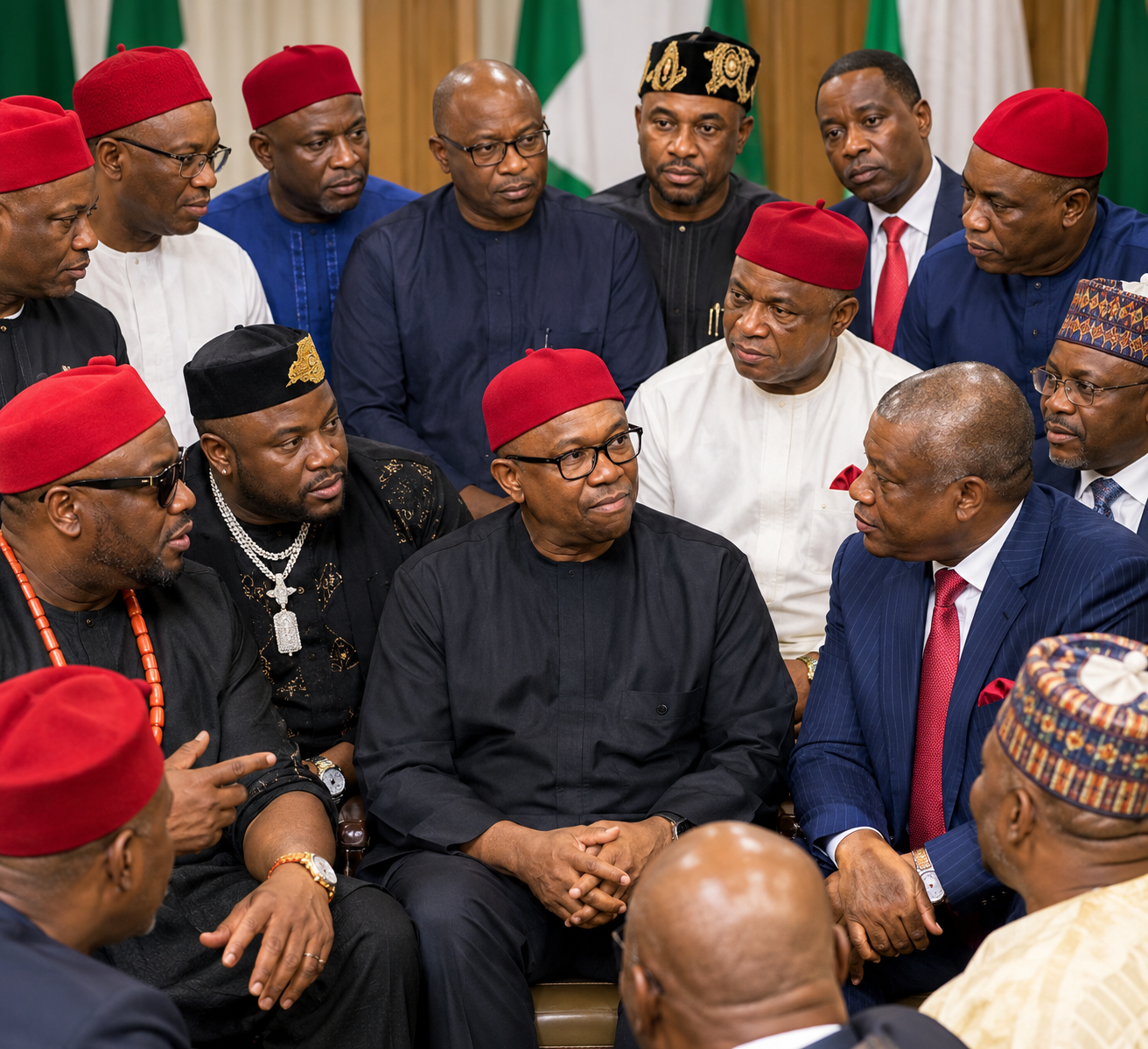



AN OPEN LETTER TO THE IGBO NATION: STOP BEING USED AS A POLITICAL TOOL; THE TIME TO PRODUCE A PRESIDENT IS NOW
My dear brothers and sisters of Alaigbo,
It is time for us to pause, reflect on our political history and make a deliberate decision about our future. For too long, the Igbo nation has played a critical role in Nigeria’s political calculations without receiving the recognition, respect and leadership opportunities it deserves. We must ask ourselves a fundamental question: How long will we continue to help others attain political power while postponing our own legitimate aspirations?
The time has come for the Igbo people to become more strategic, united and conscious of their collective interests. We must stop allowing ourselves to be used as instruments in political calculations designed primarily to serve the ambitions of other ethnic groups.
This is not a call for ethnic hostility. It is a call for political maturity, self-respect and the determination to pursue our rightful place in the Nigerian federation.
THE RECURRENT POLITICAL CALCULATION
Since Nigeria’s return to democratic rule, our politics has repeatedly revolved around alliances between the country’s dominant political blocs. In these calculations, the Igbo have often found themselves supporting presidential ambitions without securing a corresponding opportunity to produce the nation’s leader.
When northern political interests seek power, some politicians appeal to the Igbo to help weaken their opponents. When southern political interests, particularly those associated with the Yoruba political establishment, seek power, similar appeals are made to the Igbo to help achieve their objectives.
The pattern becomes even more complicated when an Igbo presidential candidate emerges. Political arrangements involving running mates from other regions, including the South-South, can become another factor in dividing support within the wider Igbo political constituency.
The result is a recurring pattern in which the Igbo contribute significantly to national political contests but remain outside the presidency.
Presidents have emerged from the North and the South-West, while Goodluck Jonathan, from the South-South, also occupied the office. Yet the Igbo have continued to struggle to translate their population, enterprise, educational achievements and national contributions into the highest political office.
We must recognise that political alliances are not inherently wrong. Every successful political movement requires partnerships across ethnic, religious and regional boundaries. The problem arises when such partnerships become instruments of manipulation rather than relationships built on mutual respect, shared objectives and measurable commitments.
The Igbo nation must learn from its political history. We cannot continue to be indispensable during elections and seemingly dispensable when power is shared.
TINUBU’S POLITICAL CHALLENGE AND THE SEARCH FOR ALLIES
President Bola Tinubu’s re-election prospects are a subject of intense political debate as Nigerians contend with economic hardship, insecurity and widespread dissatisfaction with governance.
Many Nigerians are struggling with the rising cost of living, declining purchasing power and uncertainty about their economic future. The effects of these difficulties are felt in households, markets, schools and workplaces across the country.
These challenges have created political opportunities for opposition figures, including former Vice-President Atiku Abubakar, who is seeking to capitalise on public dissatisfaction with the administration.
The North is not a politically uniform bloc, and it would be misleading to suggest that every northern voter has made the same choice. Nevertheless, any significant shift in northern political support could have serious consequences for Tinubu’s re-election calculations.
If the president faces weakening support in parts of the North, he and his political allies will have strong reasons to seek additional support elsewhere.
This is where the Igbo question becomes particularly important.
The South-East remains a crucial political constituency, while Igbo communities across other parts of Nigeria also contribute to the country’s electoral and economic life. A candidate who secures overwhelming support in the South-East and builds credible alliances with voters in other regions can strengthen their national electoral prospects.
But why should the Igbo automatically become the rescue option for a political establishment that has not adequately addressed their concerns?
Why should our votes be treated as a convenient instrument for helping others overcome political difficulties, rather than as an expression of our own aspirations for leadership?
The Igbo people must demand answers to these questions.
WE CANNOT CONTINUE TO TRADE OUR FUTURE FOR POLITICAL ACCESS
One of the greatest weaknesses in Igbo politics has been the tendency of some political leaders and influential individuals to prioritise access to power over the collective aspirations of their people.
We have seen political figures from the South-East align themselves with national power structures in the hope of securing appointments, contracts, business opportunities or political protection.
There is nothing inherently wrong with working with a president from another region. Indeed, constructive engagement with the federal government is essential for development.
However, such engagement becomes questionable when it requires the abandonment of legitimate regional concerns, the weakening of credible alternatives or the deliberate undermining of a candidate who commands substantial support among the people.
The concern today is that some influential Igbo politicians, businesspeople and public figures appear more interested in protecting their relationships with the political establishment than in advancing the collective interests of their people.
Prominent business figures such as Obi Cubana and Cubana Chief Priest, alongside other influential personalities, have attracted attention for their political activities and perceived alignment with the Tinubu camp.
Governor Chukwuma Soludo’s public criticism of Peter Obi has also generated controversy among many supporters of the former Anambra governor.
Governors Hope Uzodimma, Francis Nwifuru and Peter Mbah, alongside other political leaders from the South-East, have their own political calculations and relationships with the federal government.
These alignments are their political choices. However, the people of the South-East have every right to scrutinise them and ask whether they advance the region’s long-term interests.
Even Governor Alex Otti, whose administration has attracted attention for its reform agenda, must ultimately be judged by his decisions and the extent to which they serve Abia State and the wider interests of the Igbo people.
No individual, regardless of wealth, political office or social influence, should be allowed to define the political future of an entire people without accountability.
Our leaders must understand that political loyalty is not a substitute for results. Nor should the desire to maintain access to the corridors of power become a reason to surrender the people’s right to determine their own political direction.
THE NNAMDI KANU QUESTION AND THE DEMAND FOR EQUAL TREATMENT
The treatment of Mazi Nnamdi Kanu has become one of the most emotionally charged issues in the relationship between the Igbo people and the Nigerian state.
For many people in the South-East, his imprisonment represents more than the fate of one individual. It has become a symbol of their concerns about justice, political exclusion, security and the uneven application of the law.
The circumstances surrounding his prosecution, the conduct of the trial and the broader implications for national reconciliation have continued to generate debate.
Many Igbo people also point to the treatment of individuals and groups from other parts of the country who have been associated with violence, attacks on national infrastructure and other serious security challenges.
They question why some individuals associated with armed activities have, at different times, benefited from negotiations, rehabilitation programmes or government engagement, while they perceive the state’s response to certain expressions of dissent in the South-East as particularly severe.
These concerns deserve serious, impartial examination. The government must demonstrate that justice is applied consistently, regardless of ethnicity, political affiliation or the influence an individual commands.
A country cannot build lasting unity on perceptions of selective justice.
If Nigeria expects the Igbo people to participate fully in national politics, it must also take their concerns about security, justice, political representation and equal citizenship seriously.
No ethnic group should have to prove its loyalty by remaining silent about perceived injustice.
Equally, the pursuit of justice must remain grounded in the rule of law, peaceful political engagement and respect for human rights.
The Igbo people deserve fairness, not favouritism; equal citizenship, not political tokenism.
WHY MUST THE IGBO ALWAYS BE THE SECOND CHOICE?
Our history is filled with remarkable individuals whose intellectual contributions, professional accomplishments and national stature could have positioned them for greater leadership opportunities.
Dr Nnamdi Azikiwe, one of Nigeria’s foremost nationalists, was a towering figure in the country’s independence struggle and its early political history. Yet the First Republic’s political structure placed the prime minister at the centre of executive power, while the president occupied a largely ceremonial position.
This arrangement reflected the parliamentary system Nigeria adopted at independence. It also illustrates the difference between holding a prestigious national office and exercising the executive authority that determines the direction of government.
The experience of Azikiwe remains a reminder that political titles alone do not guarantee substantive power.
Other distinguished Igbo figures, including Chief Chuba Okadigbo and former Commonwealth Secretary-General Chief Emeka Anyaoku, have demonstrated the intellectual depth, diplomatic capacity and leadership potential within the Igbo community.
Their individual careers differed, but together they form part of a long tradition of Igbo participation in national and international affairs.
The Igbo have produced scholars, industrialists, entrepreneurs, diplomats, public servants, medical professionals, engineers and administrators whose contributions extend far beyond the South-East.
Yet, despite these achievements, the question of an Igbo presidency remains unresolved.
We must ask why a people with such a record of enterprise, educational attainment and national contribution continue to struggle for the opportunity to lead Nigeria at the highest level.
The answer cannot simply be that the Igbo lack capable candidates.
Rather, the problem must also be examined through the lenses of party structures, coalition-building, historical grievances, electoral arithmetic and the willingness of political elites across the country to support an Igbo candidate.
If we want a different outcome, we must change the political calculations that have repeatedly produced the same result.
PETER OBI AND THE OPPORTUNITY BEFORE THE IGBO NATION
Today, the Igbo have in Peter Obi a politician who has demonstrated that an aspirant from the South-East can attract substantial interest beyond his immediate ethnic constituency.
His candidacy in the 2023 presidential election generated considerable enthusiasm among young Nigerians, urban voters, professionals and supporters who wanted a different approach to governance.
For many of his supporters, Obi represents the possibility of a more accountable, prudent and people-centred government.
His appeal is not limited to the question of ethnicity. It is also connected to public concerns about the management of national resources, the quality of leadership, the cost of governance and the need to restore confidence in public institutions.
Supporters point to his record as governor of Anambra State and his emphasis on prudence, production, education, healthcare and institutional accountability.
Critics have raised their own questions about his policies, experience and capacity to build the broad political coalition required to govern Nigeria. Those questions should be addressed through open debate and scrutiny of his proposals.
Nevertheless, it would be a mistake to dismiss the political significance of the support he has attracted across regional and generational boundaries.
For the Igbo nation, Obi represents an opportunity to demonstrate that its presidential aspirations can be pursued through a candidate with a national profile rather than through political bargaining that leaves the region permanently dependent on other people’s choices.
The question before us is whether we are prepared to organise around that opportunity, build a credible national coalition and make a serious effort to turn it into electoral success.
OBI’S CHANCE MUST BE BUILT, NOT ASSUMED
There is a tendency among some of Obi’s supporters to assume that strong backing in the South-East will automatically translate into victory across Nigeria.
That assumption would be dangerous.
Winning a presidential election requires much more than regional enthusiasm. It requires nationwide organisation, credible candidates, party unity, effective mobilisation, a convincing policy programme and the ability to win the confidence of voters from different ethnic and religious backgrounds.
The South-East can provide a strong foundation for Obi’s candidacy. However, he would need to make substantial inroads into the South-South, North-Central, South-West and northern regions to establish a viable path to victory.
His supporters believe he can attract significant votes in states such as Lagos, Rivers, Akwa Ibom, Cross River, Edo, Plateau and Benue, as well as the Federal Capital Territory.
Some also believe he could make inroads into Kano and other northern states.
These are electoral possibilities, not guaranteed outcomes. Each state has its own political dynamics, voter priorities and party loyalties. Any serious campaign must study those realities rather than rely on assumptions about ethnic population or religious affiliation.
The same principle applies to Christian voters. Obi’s support among many Christians could be politically significant, but Christians are not a single voting bloc, and their decisions will depend on a variety of considerations.
The task, therefore, is not to assume that Nigeria is waiting to vote for an Igbo candidate. It is to build a credible national movement that persuades Nigerians that Obi’s leadership offers a practical response to their problems.
That is how a regional aspiration becomes a national project.
THE ECONOMY NEEDS A NEW DIRECTION
Nigeria is experiencing deep economic and social pressures. Many households are struggling to afford food, transportation, housing, healthcare and education.
Businesses face high operating costs, infrastructure deficits and uncertainty. Young people are searching for employment, while many families are worried about the future of their children.
Insecurity continues to undermine livelihoods and threaten communities in several parts of the country.
These challenges require urgent and competent leadership.
Nigeria needs a government that can restore confidence in public institutions, manage public resources responsibly, encourage productive investment, strengthen security and create an environment in which ordinary citizens can work and prosper.
It also needs a foreign policy that protects national interests, secures fair agreements and ensures that partnerships with foreign governments and companies produce tangible benefits for Nigerians.
Any claims about foreign governments collecting Nigerian revenue or obtaining mineral concessions should be examined carefully against the relevant agreements and official records. The public deserves transparency about arrangements that affect national assets and economic sovereignty.
The central question is whether Nigeria’s political leadership can deliver measurable improvements in the lives of its citizens.
For those who support Peter Obi, his presidency represents a chance to pursue a different model of governance.
But the argument for his candidacy must be made through credible policies, a realistic economic programme and clear commitments on security, education, healthcare, infrastructure and job creation.
The Igbo people should champion that debate, not merely because Obi is from the South-East, but because they believe his leadership can offer Nigeria a better future.
OUR ECONOMIC CONTRIBUTION MUST COUNT POLITICALLY
Across Nigeria, Igbo entrepreneurs and traders operate businesses, create employment, distribute goods, invest in property and support commercial networks that connect communities.
From major markets to industrial clusters, from transportation to manufacturing and technology, the Igbo have built a formidable tradition of enterprise.
Their economic activities are not confined to Igboland. Igbo communities are established in cities and towns across the federation, contributing to local economies and maintaining commercial relationships with people from different ethnic backgrounds.
This widespread presence gives the Igbo nation a significant stake in Nigeria’s political and economic future.
However, economic success does not automatically translate into political power. Nor should it be used to justify ethnic entitlement to public office.
The lesson is that our economic influence must be matched by effective civic participation, stronger political organisation and the ability to build alliances around shared national objectives.
Our businesses should not merely generate wealth. Our professional associations, community organisations, young people and political leaders should also contribute to shaping national policies.
We must become more deliberate about political participation, voter education, accountability and the development of credible leaders.
The goal should not be to replace one form of ethnic domination with another. It should be to build a Nigeria in which no region is permanently excluded from the highest levels of leadership.
THE TIME HAS COME TO BREAK THE CYCLE
My dear brothers and sisters, we cannot continue to repeat the same political choices and expect different results.
We cannot spend years complaining about marginalisation while supporting arrangements that perpetuate the very conditions we criticise.
We cannot demand an Igbo presidency in one breath and undermine a credible Igbo presidential aspirant in another simply because some influential individuals have found comfort within the existing political establishment.
We must learn to distinguish between the personal interests of our politicians and the collective interests of our people.
Our governors, legislators, business leaders, traditional rulers, clergy, professionals and young people must be prepared to engage in an honest conversation about the future of the Igbo nation.
Political differences are inevitable. Not every Igbo person must support Peter Obi, and no individual should be compelled to do so on the basis of ethnicity.
However, those who oppose his candidacy must be willing to explain the alternative they support and how that alternative advances the long-term interests of the South-East and Nigeria as a whole.
We must move beyond personality-driven politics and ask harder questions about representation, policy, accountability and national development.
If the Igbo decide that Peter Obi offers the best path forward, that decision should be expressed through peaceful mobilisation, democratic participation and the building of a credible national coalition.
We must demonstrate that our support is neither for sale nor available to whichever political establishment happens to need it at a particular moment.
Our votes must reflect our convictions, our priorities and our vision for Nigeria.
A MESSAGE TO OUR YOUNG PEOPLE AND POLITICAL LEADERS
To the young Igbo man and woman struggling to build a future in a difficult economy, understand that your political choices matter.
To the Igbo entrepreneur who employs workers and contributes to the economy, understand that business prosperity is inseparable from good governance and a stable political environment.
To our governors and elected representatives, remember that your offices are public trusts. Your political alliances must be judged by the results they deliver for your constituents.
To our traditional rulers and community leaders, use your influence to encourage dialogue, peaceful participation and the protection of the collective interests of your people.
To our intellectuals, professionals and diaspora communities, bring your knowledge, resources and international experience into the task of building a stronger political future.
And to our political parties, understand that the South-East deserves more than token appointments and election-season promises. It deserves meaningful representation, fair participation in national decision-making and a genuine opportunity to compete for the presidency.
Above all, let us reject political intimidation, ethnic hatred and the temptation to treat every disagreement as a battle between tribes.
Our struggle is not against the Hausa, Yoruba, Ijaw, Tiv, Fulani or any other Nigerian community.
Our struggle is against exclusion, injustice, poor governance and political arrangements that deny citizens a fair opportunity to participate in shaping their country’s future.
We must be able to work with Nigerians from every region without surrendering our identity or our aspirations.
THE PRESIDENCY IS NOT THE PROPERTY OF ANY ETHNIC GROUP
Nigeria belongs to all its citizens.
No ethnic group has an exclusive claim to the presidency. No region should be treated as permanently entitled to lead, and no other region should be expected to remain satisfied with supporting candidates from elsewhere.
If a candidate from the South-East possesses the competence, character, vision and political support required to lead Nigeria, that candidate should be given a fair opportunity to compete.
The same principle applies to every other region.
The Igbo must therefore pursue the presidency not as a demand for ethnic privilege but as an exercise of equal citizenship.
We should insist on a political environment in which the quality of a candidate’s ideas, integrity, experience and ability to unite the country matters more than the circumstances of the candidate’s birth.
Peter Obi’s supporters have an opportunity to make that argument convincingly. They must show Nigerians why his policies are preferable, how his government would address national challenges and how he would protect the interests of every Nigerian.
That is the standard by which a presidential campaign should be judged.
CONCLUSION: LET OUR POLITICAL CHOICES REFLECT OUR DIGNITY
My dear Igbo brothers and sisters, history has given us another opportunity to examine our political direction.
We can continue to play supporting roles in other people’s presidential ambitions, hoping that loyalty will eventually earn us a place at the centre of power.
Or we can organise ourselves, strengthen our democratic institutions, build alliances with like-minded Nigerians and pursue a credible candidate capable of competing for the presidency.
For those of us who believe in Peter Obi, the time has come to make that case with conviction, discipline and a clear understanding of the challenges ahead.
We must demonstrate that our support for him is based not merely on where he comes from, but on what we believe he can do for Nigeria.
We must also recognise that victory will require more than Igbo votes. It will require the confidence of Nigerians across the federation, including those who have different ethnic identities, religious beliefs and political experiences.
Let us therefore mobilise peacefully, persuade rather than threaten, organise rather than merely complain, and build bridges rather than deepen divisions.
Let us remind our political leaders that the people are watching and that political loyalty must never become a licence to disregard public interests.
Above all, let us reject the notion that the Igbo must always help others win the presidency while waiting indefinitely for their own opportunity.
We are Nigerians. We have contributed to the building of this country, and we have every right to participate fully in determining its future.
The Igbo nation must stop confusing political access with political power, election-season promises with genuine inclusion, and personal ambition with collective progress.
If we believe Peter Obi offers Nigeria a credible path to renewal, let us stand firmly behind that vision, build the national coalition required to realise it and give the Nigerian people a compelling reason to join us.
The time has come to pursue leadership with courage, wisdom and unity.
The time has come to make our votes count.
The time has come to build a Nigeria in which every citizen, regardless of ethnicity or region, has a fair opportunity to lead.
Let the Igbo rise—not against any Nigerian, but in pursuit of justice, equal citizenship, responsible leadership and a better Nigeria for all.
Signed,
An Igbo Writer
