
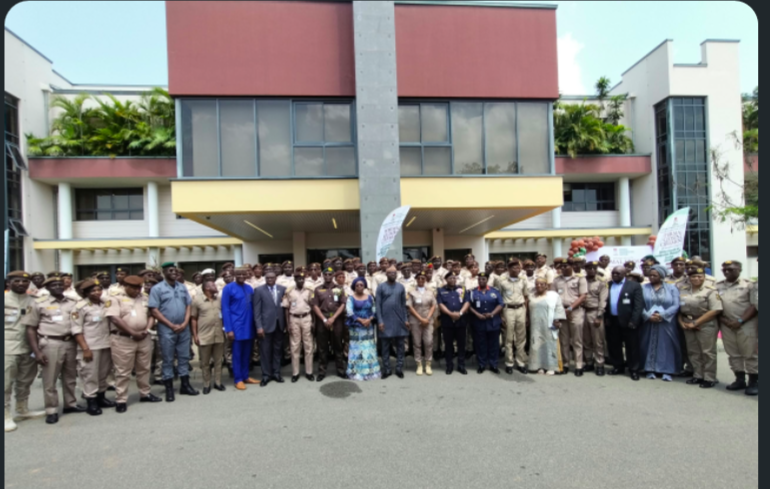



The Nigeria Immigration Service (NIS) has trained 87 officers in specialised border control and immigration management systems as part of efforts to strengthen national security, improve migration monitoring and combat transnational crimes.
The Minister of Interior, Olubunmi Tunji-Ojo, disclosed this at the closing ceremony of the specialised training held on Friday in Abuja, where he said the Federal Government was transforming the Service into a world-class, technology-driven institution through integrated data management, enhanced border security and sustained investment in personnel development.
Tunji-Ojo explained that the administration, upon assuming office, identified gaps in the technological infrastructure of the Immigration Service, particularly the lack of seamless data sharing among relevant government agencies.
According to him, fragmented databases and inadequate records of foreign nationals residing in Nigeria could undermine the government’s ability to monitor migration and address security concerns.
“We got into a system where, on official record, we had maybe about 40,000 foreigners or whatever working in Nigeria. In a country of 200 million, that’s not possible anymore. And when you do not have the data of those foreigners residing in your country, then how do you manage their affairs? And how do you monitor them? How do you monitor someone that you don’t even know exists?” he asked.
The minister stressed that migration management in a country as populous as Nigeria could no longer rely on analogue processes, noting that effective immigration control required reliable data, integrated systems and real-time information exchange.
He highlighted reforms introduced by the ministry to modernise immigration operations and strengthen information sharing among government agencies.
Tunji-Ojo disclosed that the Immigration Service had developed significant technological infrastructure, including a data centre with a capacity exceeding eight petabytes and a solar-powered facility designed to operate independently of the national electricity grid.
He added that the Federal Government was developing a 10-year technology roadmap to sustain the modernisation of immigration operations.
The minister expressed confidence that the reforms would position Nigeria as a leading provider of immigration technology and border management expertise to other countries.
Earlier, the Comptroller-General of the Nigeria Immigration Service, Kemi Nandap, said the Service had consolidated more than 15 million migration records into the Border Control Management Information System (BCMIS), giving authorised officers improved access to information on identities, movements and potential security risks.
She explained that the achievement went beyond the volume of records, noting that the system had integrated information previously scattered across different commands to support more coordinated and informed border control operations.
“BCMIS has now been able to hold over 15 million migration records. But you know what? That number is not the achievement. The achievement is that information, once scattered across our commands, now forms one coherent picture of identity, movement and risk, available to authorised officers when it matters most,” Nandap said.
However, the NIS chief cautioned that technology alone could not guarantee national security, stressing that officers must exercise sound professional judgement, uphold the law and respect travellers’ rights in the discharge of their duties.
“Technology, we all know, gives us information, but it does not give us judgement. An alert is not a verdict. A risk indicator calls for careful, proportionate examination. It never replaces evidence, professional judgement or respect for the rights of the travellers standing in front of you,” she said.
Nandap charged the officers to safeguard their assigned equipment, maintain confidentiality and ensure that every action taken through the system complied with established procedures.
“No technology is infallible. Poor data produces poor analysis. Unchecked alerts cause harm. Every officer must know when to trust the result, when to verify it, and when to escalate it,” she said.
She further urged the graduating officers to translate the knowledge acquired during the training into improved performance at their duty posts, emphasising that the responsibility for securing Nigeria’s borders ultimately rested on the personnel operating the technology.
The initiative forms part of broader efforts to modernise Nigeria’s immigration management systems, strengthen border surveillance and improve the use of data in identifying and addressing security threats.
UKATA News
