
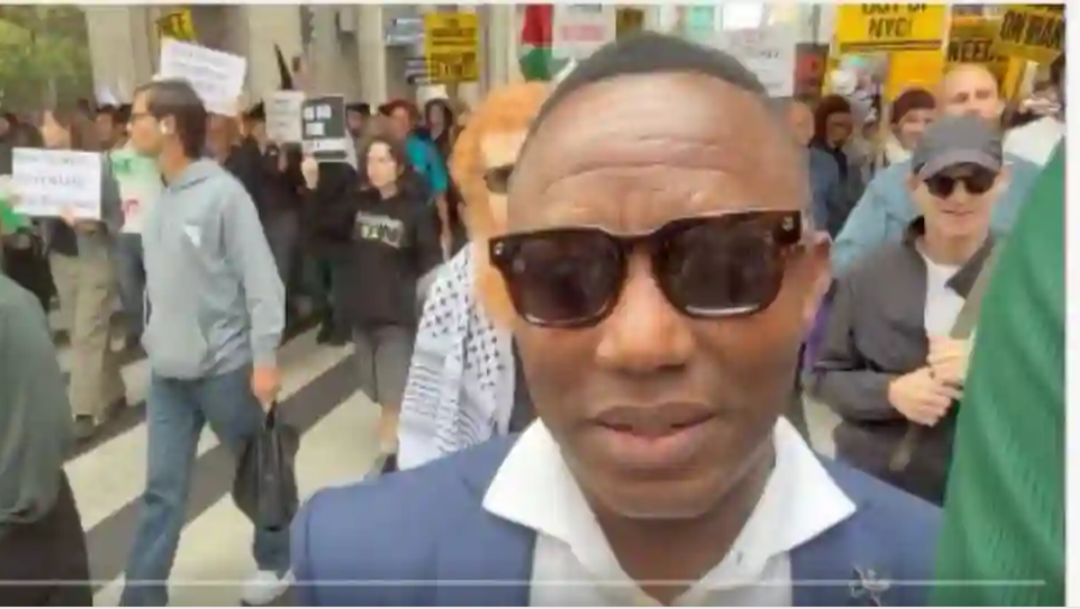



Human rights activist and African Action Congress (AAC) presidential candidate, Omoyele Sowore, has come under criticism on social media following his participation in a pro-Palestinian protest in New York during the ongoing United Nations General Assembly high-level week.
Sowore, who shared photographs and videos of himself participating in the demonstration, said he joined the protest to express solidarity with Palestinians and demand justice and respect for human rights.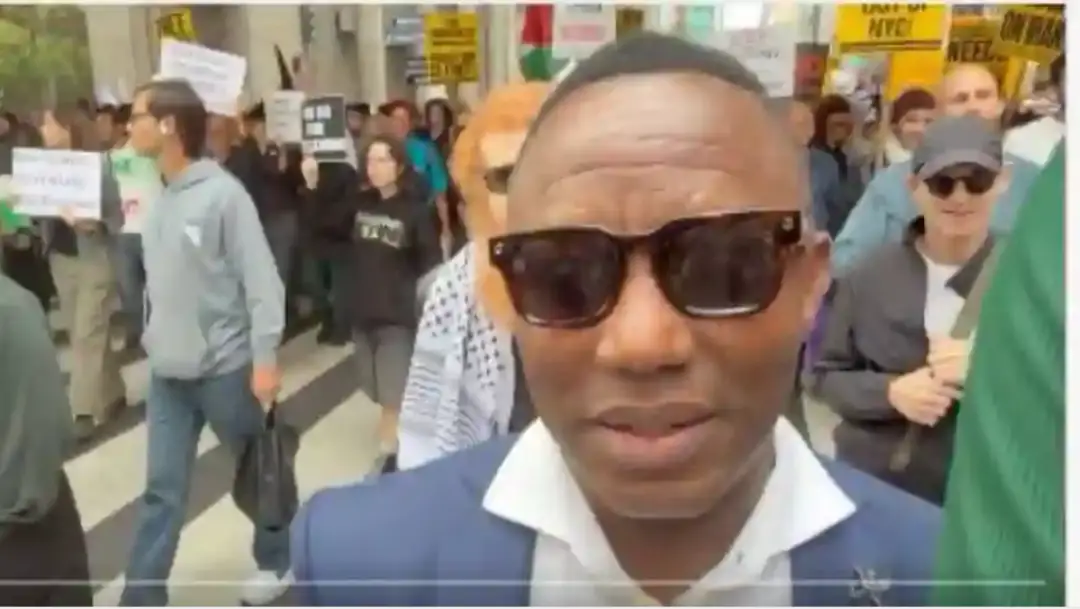
His position, however, triggered a wave of reactions from some Nigerians online, with critics questioning his decision to participate in a protest over the Israel-Palestine conflict while, in their view, Nigeria continues to grapple with serious domestic challenges.
Some of those reacting accused the activist of seeking publicity through the demonstration, while others questioned what they described as a perceived lack of equivalent attention to pressing Nigerian issues.
One critic went further, alleging that Sowore’s activities could indirectly favour the All Progressives Congress (APC)-led government. The claim, however, was presented as an opinion by the commentator and no evidence was provided in the post to establish such a connection.
Another critic specifically challenged Sowore to explain the basis of his protest against Israel, posting a lengthy historical argument about the origins of the Israeli-Palestinian conflict.
The commentator argued that Israel had historically acted defensively and cited the Ottoman Empire, Britain’s administration of Palestine, the 1917 Balfour Declaration, the 1947 United Nations partition plan and the Arab-Israeli wars of 1948 and 1967 in support of the position.
However, the historical record surrounding the conflict is considerably more complex than the account presented in the post. The United Nations says its 1947 partition proposal envisaged separate Jewish and Arab states, with Jerusalem placed under an international regime. Israel declared independence in 1948 and, following the ensuing war, expanded to about 77 percent of the territory of Mandate Palestine. The UN also records that more than half of the Palestinian Arab population fled or were expelled during the 1948 conflict.
The UN further records that Israel occupied the Gaza Strip, the West Bank and East Jerusalem during the 1967 war. The status of these territories and the broader Israeli-Palestinian conflict have remained subjects of prolonged international dispute and diplomacy.
The 2023 conflict also remains central to the debate. UN records state that Hamas and other Palestinian armed groups attacked Israel on October 7, 2023, killing more than 1,200 people and abducting 251 others. UN bodies have also documented serious allegations of violations of international law by both sides during the ensuing conflict.
Sowore has maintained his position on the Palestinian issue, publicly condemning Israel’s military campaign in Gaza and describing his participation in the New York demonstration as an expression of solidarity with Palestinians.
The controversy has consequently opened another debate among Nigerians online over the extent to which Nigerian political activists should engage with international causes while also campaigning on domestic issues.
For now, Sowore’s participation has generated both support and criticism, with the debate extending beyond the protest itself to questions about Nigeria’s domestic challenges, foreign policy and the historical roots of the Israeli-Palestinian conflict.
