
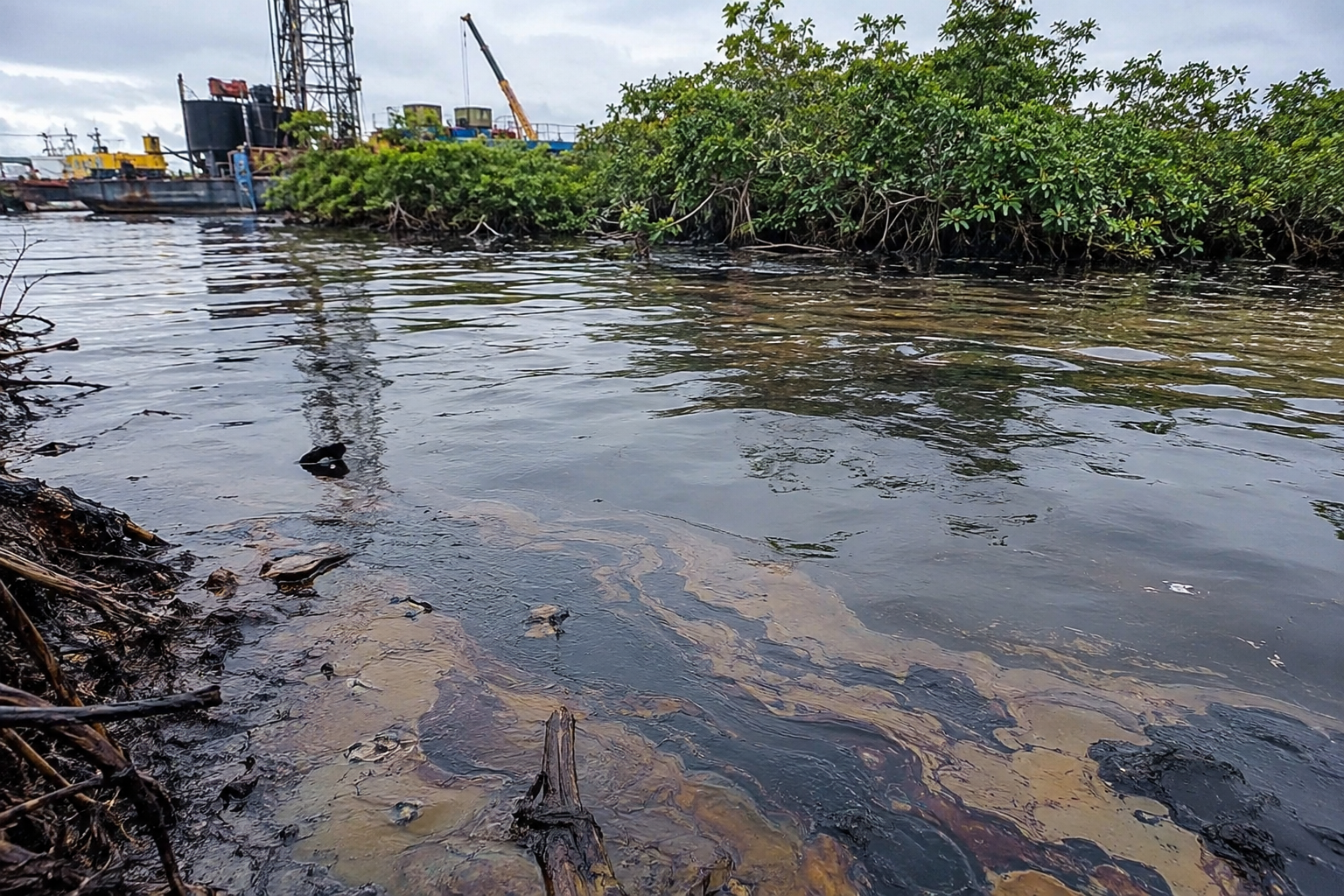



Nembe Creek Oil Spill: 20 Communities Count the Cost as Fishing Livelihoods, Mangroves Come Under Threat
JIV blames operational failure as residents inhale crude oil fumes, lose fish, oysters and periwinkles
For the fishing communities around Nembe Creek in Bayelsa State, the river is more than water.
It is their market, their kitchen, their workplace and, for many families, their only dependable source of income.
But that lifeline is now covered with crude oil.
More than 20 fishing settlements and communities around the Nembe Creek oilfield in Nembe Local Government Area are counting the cost of an oil spill which residents say has contaminated their rivers, creeks and mangrove swamps and dealt another blow to their already fragile livelihoods.
A Joint Investigation Visit, JIV, has identified operational failure as the cause of the spill from a loading barge operated by indigenous oil company, Nembe Exploration and Production Limited.
The incident reportedly occurred on Saturday, August 22, 2026, while crude oil was being loaded from a manifold into a barge.
According to residents, the manifold reportedly slanted during the loading operation, allowing crude oil to escape into the river.
Although the JIV has yet to determine the exact volume of crude spilled, the impact is already being felt by communities along the affected waterways.
‘OUR RIVER IS OUR LIFE’
For people like Joshua Robert Oruge, a native of Robertkiri, the problem is not simply about an oil spill.
It is about what happens when the river that feeds a community becomes polluted.
Oruge said repeated pollution has affected fish, oysters, crayfish and periwinkles — some of the aquatic resources on which residents depend for food and income.
For fishing families, every polluted creek represents fewer catches, lower income and a harder struggle to feed their households.
“The river is our livelihood, but each spill takes something away from us.”
CRUDE OIL IN THE AIR, CRUDE OIL IN THE WATER
The environmental damage is also being felt by residents living close to the affected waterways.
The Women Leader of Nembe Creek communities, Ebi Otokolo, and another resident, Biodomoye Kamre, said they have continued to inhale the smell of crude oil since the incident.
They also lamented the loss of their major source of livelihood — fishing.
For communities already accustomed to the devastating consequences of oil pollution, the latest incident has revived painful memories of previous spills.
The Nembe Creek oilfield is regarded as the biggest oil and gas field within OML 29.
It was originally operated by the Shell Petroleum Development Company before being divested in 2015 to Aiteo Eastern Exploration and Production Company, which has since changed its name to Nembe Exploration and Production Limited.
The construction of a crude oil tank farm within the Nembe Creek facility and the subsequent loading and transportation of crude oil by vessels have, according to the report, been associated with several spills in the area.
Communities in Nembe have previously witnessed major oil spill incidents, including the Santa Barbara OML 29 Well 1 spill in 2019 and another incident in 2021, when crude oil reportedly flowed into the river for about a month before it was contained.
ANOTHER SPILL, ANOTHER CALL FOR HELP
Now, residents say they are once again being forced to pay the environmental and economic price.
Chief Agent Anthony Waya, the overall paramount ruler of Nembe Creek communities, said the affected people have continued to suffer the devastating consequences of repeated oil spills.
He accused the company operating the facility of showing insufficient concern for the plight of the affected communities.
CHIEF AGENT ANTHONY WAYA
Environmental watchdog Environmental Conservation Agriculture and Rural Development, ECARD, has also raised concerns over the incident.
Its Chief Operating Officer, Chief Alagoa Morris, described the pollution as unfortunate and called for a comprehensive cleanup and remediation of the affected waterways.
He also urged the authorities and relevant stakeholders to provide relief materials and compensation for people whose livelihoods have been affected.
WHO WILL PAY THE PRICE?
For the people of Nembe Creek, however, cleanup cannot come too late.
Every day crude oil remains in the waterways is another day fishing families struggle to make a living.
Another day mangroves remain contaminated.
Another day aquatic life is exposed to pollution.
And another day residents say they are forced to breathe the smell of crude oil in an environment that should be sustaining them.
Although a Joint Investigation Visit has been conducted, Nembe Exploration and Production Limited has not publicly reacted to the incident.
Efforts by reporters to obtain the company’s response were unsuccessful, as messages sent to the company were not answered.
The affected communities are now asking government and relevant regulatory agencies to move beyond investigation and act.
They are calling for immediate containment and cleanup of the affected waterways, relief for affected residents and compensation for those who have lost their means of livelihood.
They are also demanding safer and more reliable methods of transporting crude oil, particularly questioning the continued dependence on barges for crude evacuation in an environmentally sensitive area.
For the people of Nembe Creek, this is not just another oil spill report.
It is about fish that may no longer be available, mangroves that may take years to recover, families that have lost income — and a river that has become a source of fear instead of food.
