
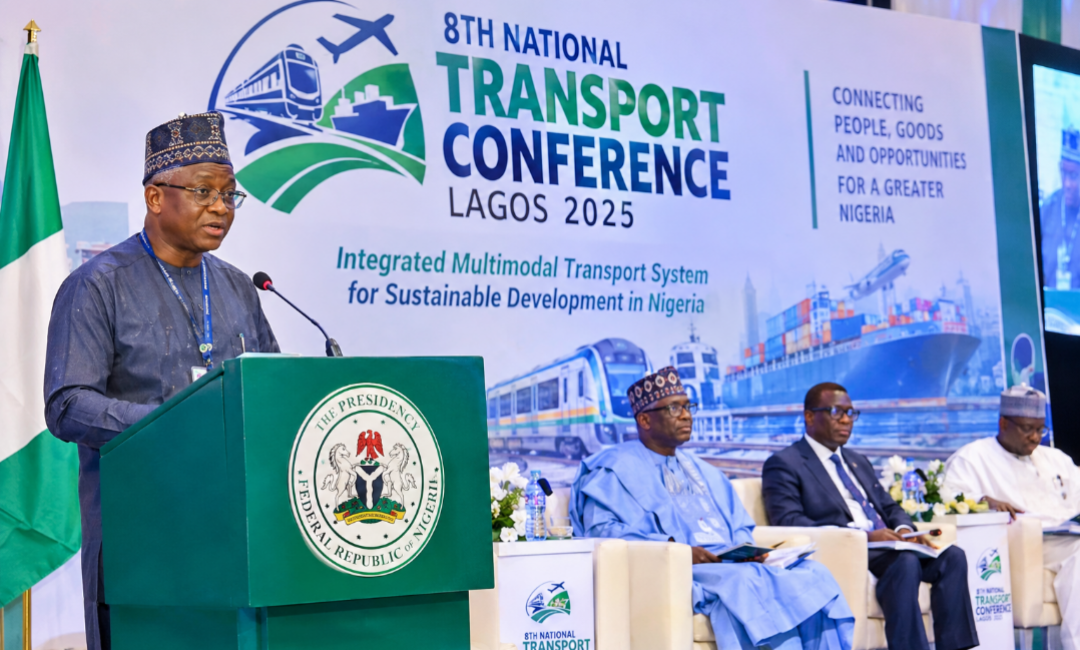



President Bola Tinubu and Lagos State Governor Babajide Sanwo-Olu have reaffirmed their commitment to investment in transportation infrastructure, with a call for better integration of road, rail, maritime and air transport to promote economic growth and sustainable development.
The leaders made their positions known at the eighth National Transport Conference in Lagos, which brought together transportation professionals, policymakers, investors, operators and other stakeholders to discuss the future of Nigeria’s transport sector.
The conference in 2025
President Tinubu, represented by the Permanent Secretary in the Federal Ministry of Transportation, Mr Olufunsho Adebiyi, declared the conference open, describing its theme, “Integrated Multimodal Transport System for Sustainable Development in Nigeria,” as timely and consistent with the government’s efforts to improve connectivity across the country’s transport networks.
The President noted that transportation goes beyond the movement of people and goods, describing it as critical infrastructure that connects farms to markets, businesses to consumers and communities to economic opportunities.
He reaffirmed his administration’s commitment to prioritising the transport sector through infrastructure investments aimed at creating jobs, improving mobility and strengthening the movement of goods and services across the country.
Governor Sanwo-Olu, represented by his Special Adviser on Transportation, Mr Shola Giwa, said the Lagos State Government would sustain investments in transport infrastructure through road construction, rail expansion and the addition of buses and ferries to the state’s transport network.
According to him, these investments are intended to make transportation more affordable, reduce travel delays and facilitate the movement of people and goods.
The governor stressed that the future of transportation in Nigeria would depend not only on the volume of infrastructure developed but also on how effectively the different transport systems are connected.
He highlighted Lagos State’s efforts to integrate road, rail and water transportation to improve mobility and provide more efficient and affordable services for residents.
In his welcome address, the President of the Chartered Institute of Transport Administration of Nigeria, Dr Segun Obayendo, said transportation was fundamental to economic growth, community development, national unity and the creation of opportunities.
He explained that an integrated multimodal transport system was essential to achieving sustainable development, noting that safety, professionalism, effective governance, technology and investment must work together to deliver meaningful results.
Obayendo cautioned against treating different transport modes as isolated systems, stressing that no modern economy could achieve its full potential without effective connections between roads, railways, seaports, airports and inland waterways.
He illustrated the importance of integration with the agricultural sector, explaining that farmers in rural communities require efficient roads to move produce to collection centres, rail services to transport goods to inland terminals, and road and maritime connections to reach seaports and international markets.
The institute president called for stronger connections among railway stations, seaports, airports, inland waterways, logistics parks and urban transport terminals.
He also advocated the harmonisation of transport data, ticketing systems, safety standards, regulations and investment frameworks to ensure seamless movement across the different modes of transportation.
Beyond infrastructure development, Obayendo emphasised the need to strengthen professional capacity within the transport sector.
He observed that investments in roads, railways, terminals, airports and waterways would deliver limited benefits without qualified personnel to plan, manage, regulate, operate and maintain the facilities.
According to him, transportation is a specialised profession requiring expertise in transport economics, logistics, supply-chain management, infrastructure planning, safety administration, intelligent transport systems, regulatory compliance, environmental sustainability and public-sector governance.
The conference provided a platform for stakeholders to examine existing challenges, explore innovative solutions and strengthen partnerships among government institutions, transport professionals, investors, operators and the public.
Discussions centred on the need to move beyond individual infrastructure projects towards a coordinated transport system capable of supporting economic development, improving accessibility and delivering more reliable services to Nigerians.
