



The successful surgery performed on Pope Leo XIV to remove the lower lobe of his right lung has brought renewed attention to lung cancer, one of the world’s leading causes of cancer-related deaths, while raising questions about the pontiff’s recovery and long-term prognosis.
The Vatican confirmed on Tuesday, October 13, that the Pope underwent thoracic surgery at Rome’s Gemelli Hospital after doctors detected a localised nodule in his lung.
A medical examination conducted during the operation confirmed that the growth was lung adenocarcinoma, a common form of lung cancer.
According to the Holy See Press Office, the operation was successful, with no complications reported. The Pope awoke normally after the procedure and returned to his hospital room following a brief period of observation.
The surgery itself lasted approximately 90 minutes, although the Pope spent about three hours in the operating room.
The medical team, led by Professor Stefano Margaritora, removed the lower lobe of the Pope’s right lung using a video-assisted surgical technique intended to ensure the complete removal of the affected tissue.
The Vatican said further examinations would be conducted on the removed tissue, while the previously announced hospitalisation period of approximately one week remained unchanged.
However, the confirmation of cancer has drawn attention to the seriousness of the disease, its potential fatality and the importance of early diagnosis.
Understanding Lung Adenocarcinoma
Lung adenocarcinoma is a type of non-small cell lung cancer that develops in glandular cells in the lungs, including cells that produce substances such as mucus.
It is one of the most common forms of lung cancer and can occur in smokers, former smokers and people who have never smoked.
The disease often develops in the outer regions of the lungs. Although some cases grow relatively slowly, others can spread to nearby lymph nodes or distant organs if not detected and treated in time.
Common symptoms of lung cancer include a persistent cough, chest pain, shortness of breath, coughing up blood, unexplained weight loss and persistent fatigue.
However, early-stage lung cancer may produce no obvious symptoms and can be discovered during medical examinations conducted for other reasons.
In Pope Leo XIV’s case, the Vatican had earlier reported that doctors discovered a localised lung nodule during medical examinations. The Pope indicated that it had been detected at an early stage and was well localised.
Although a lung nodule does not necessarily indicate cancer, the subsequent examination of tissue removed during the Pope’s operation confirmed lung adenocarcinoma.
The confirmation establishes the presence of cancer, but the Vatican has not publicly disclosed the tumour’s precise stage, whether cancer cells were present in nearby lymph nodes or whether additional treatment would be required.
How Fatal Is Lung Cancer?
Lung cancer remains one of the deadliest cancers globally, partly because many cases are diagnosed after the disease has spread beyond the lungs.
However, the fatality associated with the disease varies considerably depending on the type of cancer, the stage at diagnosis, the patient’s general health and the effectiveness of treatment.
Data published by the United States National Cancer Institute’s Surveillance, Epidemiology, and End Results programme show that the five-year relative survival rate for lung and bronchus cancer is approximately 65.5 per cent when the disease is localised, meaning it has not spread beyond its original site.
The rate falls to approximately 38.2 per cent when the cancer has spread to nearby lymph nodes or structures and 10.5 per cent when it has spread to distant parts of the body.
These figures demonstrate the importance of detecting and treating lung cancer before it spreads.
The statistics are based on populations of patients in the United States and cannot be used to predict an individual’s outcome. They also cover lung and bronchus cancers collectively rather than providing a precise survival estimate for Pope Leo XIV’s particular tumour.
The figures do not mean that the Pope has a 65.5 per cent chance of survival. His individual prognosis cannot be determined without further information about the stage and characteristics of his cancer, the completeness of the surgical removal and his subsequent medical assessment.
Does the Removal of a Lung Lobe Improve the Outlook?
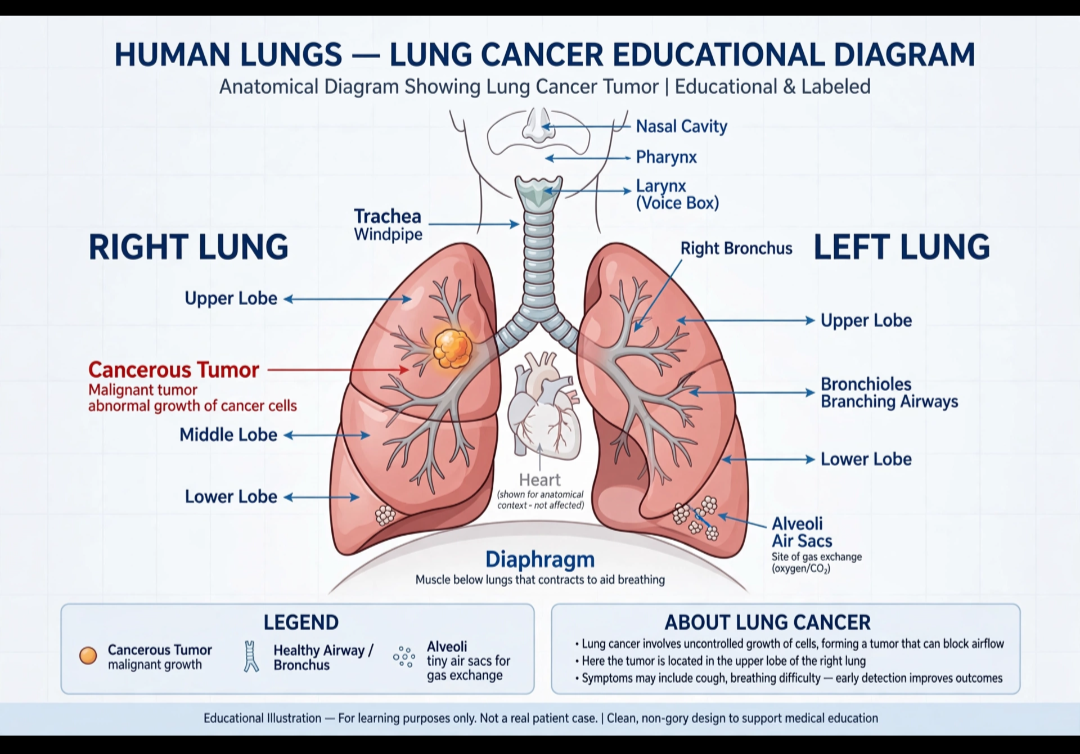
The removal of the lower lobe of the Pope’s right lung is a form of surgery known as a lobectomy.
The lungs are divided into sections called lobes. The right lung has three lobes, while the left lung has two.
A lobectomy involves removing one lobe containing the tumour and is a recognised treatment for certain patients with localised non-small cell lung cancer.
The objective is to remove the cancerous tissue completely while preserving as much healthy lung tissue as possible.
For appropriately selected patients whose cancer has not spread, surgery can offer a potentially curative treatment.
Nevertheless, successful surgery does not automatically mean that the cancer has been permanently eliminated. Doctors may need to examine the removed tissue, assess the surgical margins and determine whether lymph nodes are affected.
Depending on the findings, some patients require additional treatment, such as chemotherapy, targeted therapy or immunotherapy, while others may be monitored following surgery.
The Vatican’s announcement that the operation was successful and free of complications is encouraging regarding the immediate surgical outcome.
However, the Pope’s longer-term prognosis will depend on the results of further examinations and the medical team’s assessment.
How Does Pope Leo’s Condition Compare With the Illness That Killed Pope Francis?
The latest development has inevitably recalled the death of Pope Francis, who died on April 21, 2025, at the age of 88.
However, the officially documented circumstances surrounding the deaths of the two pontiffs are medically different.
According to the Vatican’s official death certification, Pope Francis died following a stroke, which led to a coma and irreversible cardiovascular collapse.
The medical report also documented a history of acute respiratory failure associated with bilateral pneumonia caused by multiple microorganisms, multiple bronchiectases, high blood pressure and Type II diabetes.
Bronchiectasis is a chronic condition in which the airways become abnormally widened and damaged, making it more difficult to clear mucus and increasing susceptibility to recurrent respiratory infections.
Pneumonia, meanwhile, is an infection that causes inflammation in the lungs and can become life-threatening, particularly among older people and those with underlying health conditions.
Pope Francis had experienced serious respiratory difficulties before his death, including a prolonged hospitalisation for pneumonia in early 2025.
His official cause of death, however, was recorded as a stroke followed by a coma and irreversible cardiovascular collapse, against the background of his other medical conditions.
By contrast, Pope Leo XIV’s currently disclosed diagnosis is lung adenocarcinoma, and his immediate medical intervention involved the surgical removal of the affected portion of his right lung.
There is no publicly established medical link between the cancer diagnosed in Pope Leo XIV and the conditions that led to Pope Francis’s death.
The comparison highlights the different ways serious illnesses can affect the health of elderly patients, but it would be medically inaccurate to suggest that the two pontiffs suffered from the same disease.
The Wider Health Implications
The development also highlights the importance of early diagnosis and appropriate medical intervention in the management of serious illnesses.
Lung cancer can be particularly difficult to detect in its early stages because symptoms may be absent or mistaken for other respiratory conditions.
When the disease is discovered before it spreads, treatment options may be more effective and the chances of long-term survival are generally better.
Risk factors include tobacco smoking, exposure to second-hand smoke, air pollution, radon and certain occupational carcinogens. However, lung cancer can also develop in people without a history of smoking or any clearly identifiable exposure.
Medical professionals therefore emphasise the importance of appropriate assessment of suspicious lung nodules, particularly when imaging or other tests indicate a possibility of cancer.
In the Pope’s case, the discovery of a localised lung nodule prompted further medical investigations and eventually surgery.
The procedure has removed the affected lobe, but further examinations will help establish the full extent of the disease and whether additional treatment is necessary.
Prayers and Hopes for Recovery
Meanwhile, Catholics in Nigeria have continued to offer prayers for Pope Leo XIV following the announcement of his surgery.
Ministers of the Catholic Charismatic Renewal in the Lagos Archdiocese received a notice calling for special prayers for the Holy Father as he prepared for the operation.
The prayers reflect the spiritual concern of Catholics who regard the Pope as the spiritual leader of the worldwide Catholic Church.
As the pontiff begins his recovery, attention will remain on updates from the Vatican concerning his post-operative condition, the results of further examinations and any additional treatment recommended by his doctors.
Sources: Vatican News; Holy See Press Office; American Cancer Society; US National Cancer Institute; official Vatican medical certification of Pope Francis’s death.Important editorial note
Thank you for reading! Always visit our website for more equally enriching stories. You can also follow us on our Facebook page to get news updates as they drop.
UKATA News
