



OK Movement: Stop Attacking Peter Obi, Nigerians Deserve a Change of Direction
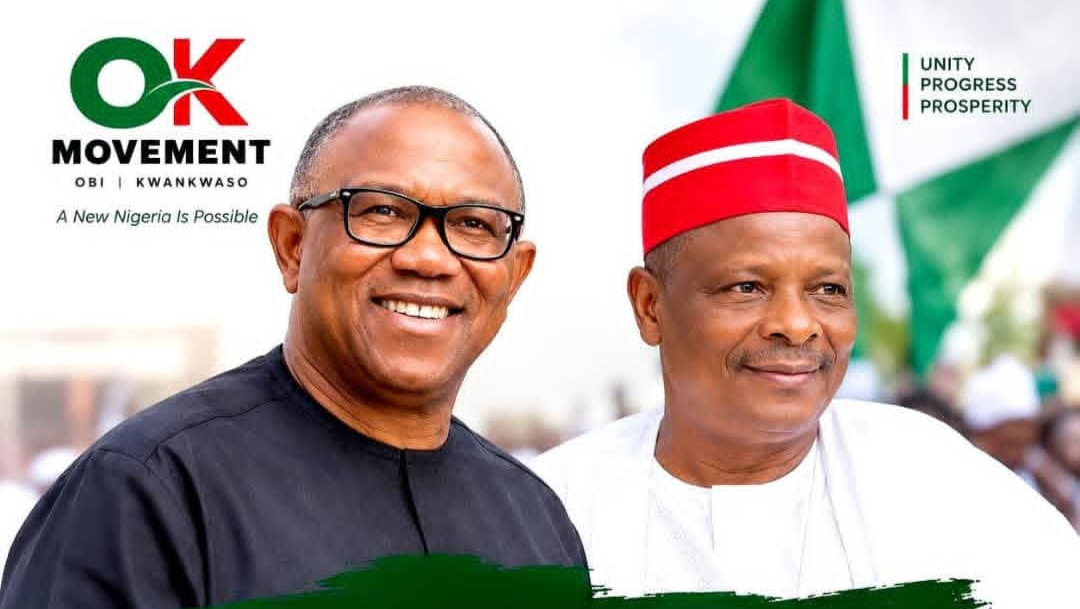
The Peter Obi–Rabiu Kwankwaso-backed OK Movement has called on the ruling All Progressives Congress (APC) and its supporters to stop what it described as persistent attacks on Peter Obi, arguing that such attacks would not address the economic and security challenges confronting Nigerians.
Obi is the presidential candidate of the Nigeria Democratic Congress (NDC) for the 2027 general election, while Rabiu Musa Kwankwaso is the party’s vice-presidential candidate. The NDC formally affirmed the ticket at its special convention in Abuja in May.
In a statement titled “A Different Direction for Nigeria: Nigeria Needs a Change of Direction, and Obi/Kwankwaso Is That Conversation,” the OK Movement argued that the political debate should focus less on personal attacks and more on the issues affecting ordinary Nigerians.
The group described Obi as a political figure whose record and policy positions have attracted sustained scrutiny from opponents, alleging that some of the criticisms directed at him amount to verbal attacks and blackmail rather than substantive engagement with his proposed programmes.
It urged Nigerians to demand greater accountability from those in power and to examine whether current economic policies are delivering meaningful improvements in their daily lives.
“For more than three years, Nigerians have been told that the difficult economic reforms would eventually produce relief. Yet today, the cost of living remains painfully high,” the group stated.
Available economic data present a mixed picture. The National Bureau of Statistics reported that headline inflation eased marginally to 15.39 per cent in August 2026, from 15.43 per cent in July, while food inflation stood at 19.57 per cent year-on-year.
At the same time, petrol prices have risen to about ₦1,400 per litre in Lagos and Abuja, with prices reaching around ₦1,500 in some parts of northern Nigeria, according to recent reports.
For households, the movement in prices has consequences beyond economic statistics. Higher transport and energy costs affect commuters, traders, manufacturers, farmers and small businesses, while families must continually adjust how they spend limited incomes.
The OK Movement also raised concerns about insecurity, citing the mass abductions in Niger State in August. Reuters reported that residents in the Borgu area recently protested over the continued captivity of hundreds of people abducted during the August 21 attacks. Local estimates put the number of missing persons at nearly 700, although the exact figure remains difficult to independently verify.
Electricity was another area highlighted by the group. The Minister of Power, Joseph Tegbe, recently disclosed that generation and transmission had exceeded 5,000 megawatts in recent weeks, with generation reaching a peak of 5,330MW in August and September. He also acknowledged that the improvement had yet to translate into reliable electricity for many Nigerians.
Against this backdrop, the OK Movement said the conversation about Obi and Kwankwaso should extend beyond personalities to the policy direction they are proposing for Nigeria.
The group said Obi’s economic agenda places emphasis on production, investment, enterprise and human-capital development, with agriculture, manufacturing, technology, energy, education and healthcare identified as key areas for national development.
It also presented the Obi–Kwankwaso partnership as combining different political and policy experiences, describing the ticket through the values of character, competence, compassion, capacity and commitment.
According to the movement, Nigeria’s challenge is not simply a shortage of resources but the need to convert its human and natural resources into productive capacity, jobs and improved public services.
The group called for greater attention to making agriculture more productive, strengthening manufacturing, improving education and healthcare, expanding reliable electricity supply and ensuring greater accountability in the management of public resources.
“Nigeria does not need another government whose success is measured mainly by speeches, ceremonies and statistics that ordinary people cannot feel,” the statement said.
The OK Movement further argued that the 2027 political conversation should focus on the country’s structural challenges rather than being reduced to arguments over tribe, religion or personalities.
It said Nigerians should ask whether the country will continue managing the consequences of longstanding economic and institutional problems or pursue policies designed to create productive capacity, strengthen institutions and expand opportunities.
“Nigeria has the people. Nigeria has the resources. Nigeria has the talent. What Nigeria needs is leadership capable of turning those advantages into results,” the group stated.
The movement concluded by presenting the Obi–Kwankwaso ticket as its proposed alternative direction for Nigeria ahead of the 2027 elections.
Innocent/Paula
