
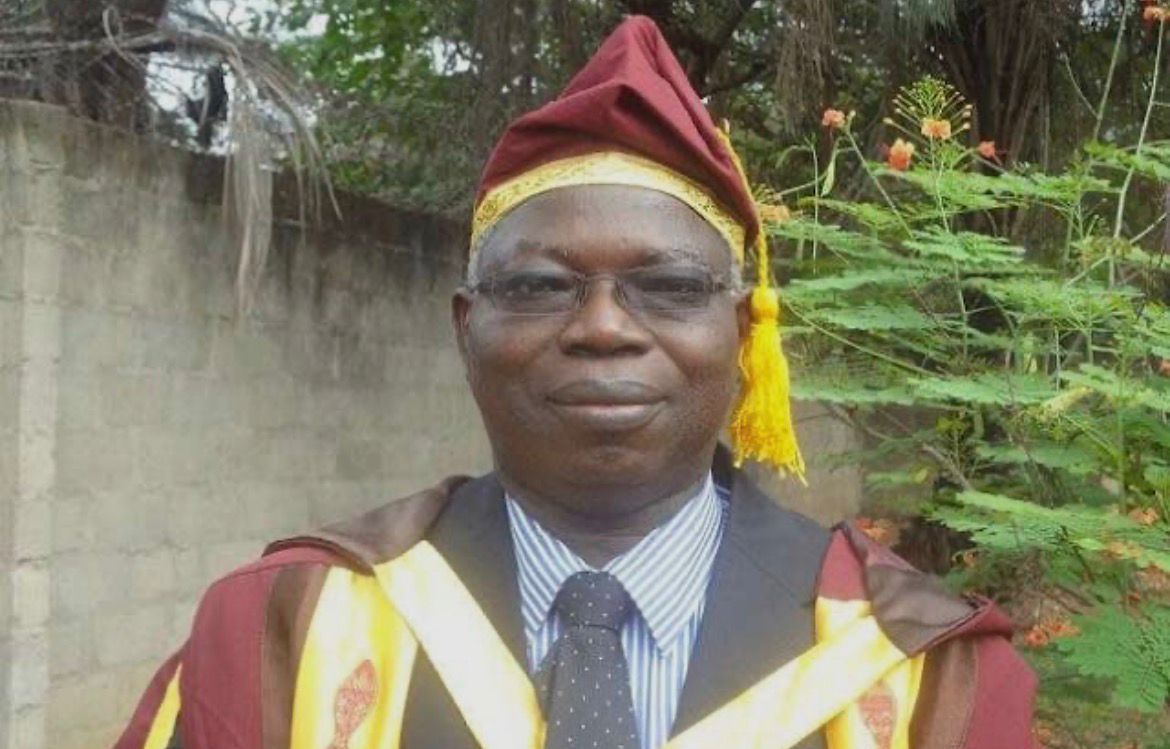



He said schools should receive greater security attention because of the repeated attacks on educational institutions and the abduction of pupils, students and teachers.
Soyombo further called for the deployment of modern technology and sophisticated equipment to enable security agencies to confront criminals, terrorists and bandits more effectively.
“Our strength is not so much in how many security personnel we have but how well-equipped they are,” he said.
He explained that modern security operations were increasingly technology-driven, stressing that a well-equipped security officer could achieve far more than a large number of poorly equipped personnel.
The professor also called for stronger intelligence sharing and better coordination among security agencies, saying closer collaboration would improve their ability to detect and prevent crimes before they occur.
“They will be stronger, more efficient, and more effective when they work together,” he said.
Soyombo identified effective border management and stricter control of small arms and light weapons as other measures needed to tackle trans-border crime and the proliferation of illegal weapons.
He also urged the government to enforce mining regulations and intensify the fight against illegal mining, which he said had contributed to insecurity and terrorism in some communities.
On the justice system, Soyombo called for appropriate punishment for offenders, warning that impunity could encourage more people to engage in criminal activities.
He urged security agencies and prosecutors to pursue cases diligently so that suspects do not escape justice through abrupt termination of cases or extra-judicial release.
The don also urged security agencies to make greater use of science and technology, including forensic science, closed-circuit television (CCTV), aerial surveillance, drones and modern communication systems.
He said such technologies could assist security agencies in tracing, tracking, identifying and apprehending criminals, while cautioning that criminals could equally exploit technological advances.
“Thus, the police and security agencies must always improve and update their knowledge, training, and capacity,” he said.
Soyombo stressed that Nigeria’s insecurity was multi-dimensional and could not be solved through a single intervention.
“It is necessary to note that there is no single-item, one-fix solution to the problem of insecurity in Nigeria,” he said.
Beyond policing and military responses, the professor linked the country’s security challenges to what he described as a decline in social values, including honesty, hard work and integrity.
He expressed concern over the shortage of positive role models in society, noting that young people often learnt more from the conduct of leaders than from their public speeches.
Soyombo used the lecture to challenge Nigerians to examine their individual and collective responsibilities in creating a safer country.
He urged citizens to take responsibility for problems they have the capacity to address, stressing that the government and security agencies cannot solve every challenge alone.
“As some are wont to say, God will not come down to do for a people what they have the capacity to do for themselves,” he said.
