
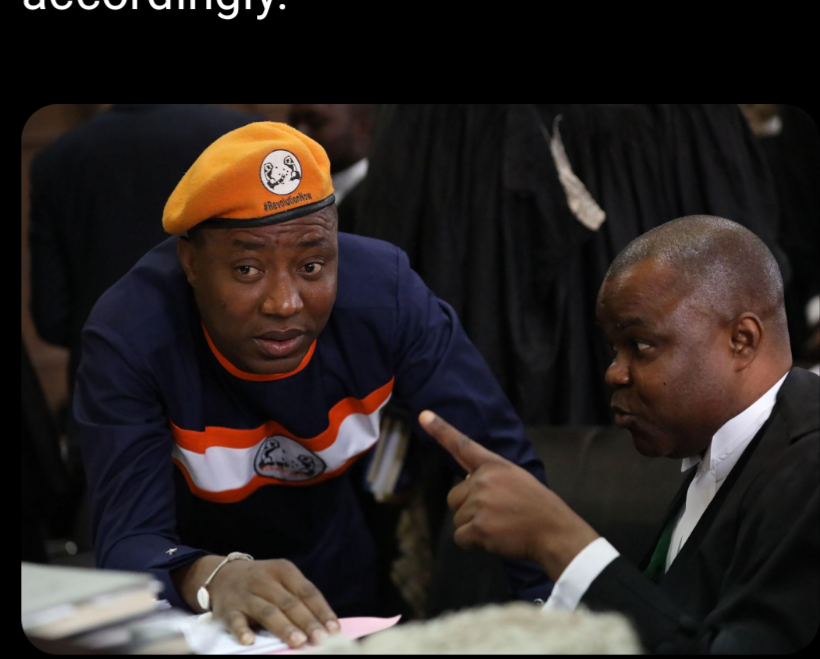



Sowore Insists on DSS DG’s Appearance as Witness in Tinubu Defamation Case
Human rights activist and Convener of the #RevolutionNow movement, Omoyele Sowore, has insisted that the Director-General of the Department of State Services (DSS), Mr Tosin Ajayi, must appear before the Federal High Court in Abuja to give evidence in the defamation case involving President Bola Tinubu.
Sowore’s insistence followed a breakdown in an understanding between his counsel, Mr Adeyinka Olumide-Fusika, SAN, and the prosecution counsel, Mr Akinlolu Kehinde, SAN, over the appearance of the DSS Director-General as a witness.
Olumide-Fusika had earlier obtained an order of the court compelling the DSS Director-General to appear and give evidence in the case.
However, following the intervention of the Attorney-General of the Federation and Minister of Justice, Prince Lateef Fagbemi, SAN, an understanding was reportedly reached that an officer of the DSS could appear in place of the Director-General.
The arrangement, however, broke down after no proper arrangements were made to ensure the appearance of the proposed witness in court.
Addressing the court, Olumide-Fusika said he had been informed that a hearing notice had been served on the DSS but had seen no indication that the Director-General was present in court.
He said the parties had previously agreed that an officer of the service, rather than the Director-General, would appear as a witness.
“At the last adjourned date, we had an understanding that rather than pursuing the DG to appear, we opted for any officer to appear.
“Since no witness is here, we are insisting now that the DG himself should come. The order of the court and the hearing notice were directed at him, so he has to be in court.
“The prosecution repudiated the understanding we had; therefore, the DG has to come. The subpoena did not say any officer; it was directed specifically to the DG,” he said.
Sowore’s counsel also argued that the Attorney-General of the Federation had not filed any process in the matter, insisting that his submissions on the day he appeared before the court should not be relied upon, as he was not the person who filed the charge.
Olumide-Fusika maintained that the agreement to allow another DSS officer to testify was reached based on the intervention of the Attorney-General, adding that the prosecution had now reneged on the arrangement.
“For the prosecution to come to court this morning and behave as if there was never any understanding, we must draw a line. We are tired of being tossed around,” he said.
In his response, prosecution counsel, Akinlolu Kehinde, SAN, argued that the court’s records showed that the DSS was expected to produce an officer to confirm the availability of the nominated witness.
He maintained that the prosecution was ready to proceed with the case, insisting that a DSS officer was available to testify.
Kehinde explained that during proceedings on July 28, 2026, the Attorney-General had argued that it would be inappropriate for the DSS Director-General to appear in court in his personal capacity when the matter concerned his official position.
He said the argument informed the decision to have another officer of the service testify in place of the Director-General.
“The DG of DSS’ name appears in the subpoena in his personal capacity, and the AGF argued that where the name of a person acting in an official position appears in a subpoena, it would be absurd for the person to come to court because it is not a personal matter.
“That is why an officer from that office is here to give evidence. He has no personal interest in this matter. Therefore, if they are not willing to go on, the court should close their case because we must make progress in this matter.
“The witness from the DSS is available. It is not an act of charity that the prosecution agreed to send an officer,” Kehinde said.
The disagreement has brought the proposed appearance of the DSS witness into contention, with both parties maintaining opposing positions on the interpretation of the earlier understanding and the court’s order.
