



Alake Backs South-South Push to Unlock Nigeria’s Hidden Mineral Wealth
From lithium and gold to iron ore, barite and lead-zinc, experts say Nigeria could build a new industrial economy if its minerals are properly explored, processed and linked to manufacturing
Nigeria may be sitting on one of its biggest economic opportunities outside crude oil—and it is buried beneath the ground.
From lithium and gold to iron ore, limestone, barite, lead-zinc, tin, tantalite, coal and bitumen, the country has a remarkable spread of mineral resources across its 36 states and the Federal Capital Territory.
The Federal Ministry of Solid Minerals Development says Nigeria has at least 44 mineral deposits in commercial quantities spread across more than 500 locations covering the six geopolitical zones.
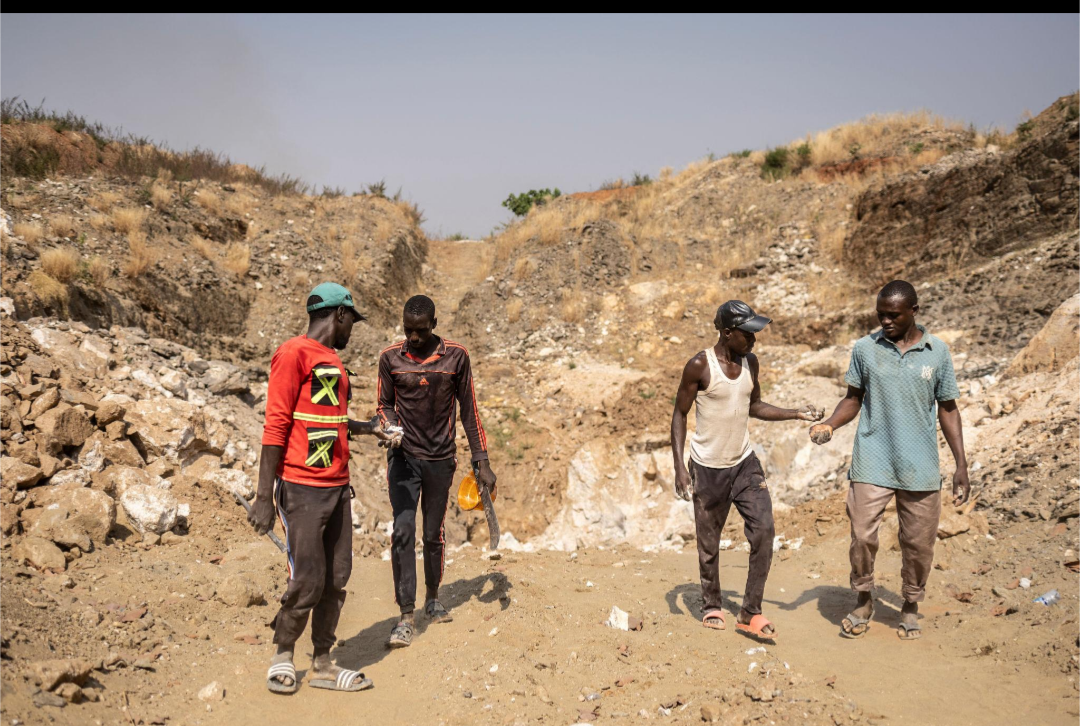
Yet, for decades, the country has extracted only a fraction of this potential, with much of the sector dominated by informal and artisanal activities and the export of minerals with limited processing.
That reality is now coming under renewed scrutiny as the Federal Government seeks to make solid minerals a major pillar of economic diversification.
The latest push is coming from the South-South Development Commission (SSDC), which is seeking a stronger partnership with the Federal Ministry of Solid Minerals Development to turn the region’s mineral resources into investments, jobs and industrial opportunities.
The Minister of Solid Minerals Development, Dr Dele Alake, has pledged the Ministry’s support for the initiative.
Alake gave the commitment when the Director-General of the SSDC, Ms Usoro Offiong Akpabio, led a delegation of the Commission on a courtesy visit to the Ministry in Abuja to discuss regional development and the exploitation of mineral resources.
According to a statement by the Minister’s Special Assistant on Media, Lara Owoeye-Wise, Alake said the engagement was important to the Federal Government’s broader strategy of using the six geopolitical development commissions established by President Bola Ahmed Tinubu to accelerate development across the regions.
The Minister noted that although the South-South is traditionally associated with Nigeria’s oil and gas industry, its mineral endowment could make the region an important part of the country’s diversification drive.
He said reforms by the Ministry were repositioning mining to support industrialisation through local value addition, responsible mining, investment promotion and stronger regulation.
The Minister also pointed to increased investment in the sector, including foreign direct investment and the emergence of mineral-processing facilities.
He encouraged South-South states to take advantage of the Federal Government’s framework allowing states to participate directly in mining through properly structured Special Purpose Vehicles (SPVs) and valid mining titles.
Several states, he said, had already secured mining licence approvals through the framework.
But Alake cautioned states against creating conflicting or unilateral mining policies, stressing that investors need a predictable regulatory environment.
“We have a commonality of objective, we just need to harmonise our strategies and tactics to achieve it,” he said.
For the SSDC, the ambition goes beyond simply digging minerals out of the ground.
Akpabio said the Commission was seeking practical collaboration with the Ministry on sustainable mining, environmental innovation, investment and job creation.
She also identified the formalisation and training of artisanal miners, with the support of state authorities and security agencies, as part of the proposed partnership.
Nigeria’s buried economic opportunity
The scale of the opportunity becomes clearer when Nigeria’s current mining performance is compared with the size of its mineral endowment.
NEITI’s 2023 Solid Minerals Industry Audit found that the sector contributed about ₦1.76 trillion, or 0.75 per cent, to Nigeria’s GDP, while solid minerals accounted for only about ₦35.87 billion, or 0.28 per cent, of the country’s total exports that year.
In other words, the country’s mineral wealth is enormous, but its economic contribution remains relatively small.
That is precisely where the opportunity lies.
The Ministry’s own data show strong recent growth in some strategic minerals. Between 2023 and 2024, royalties from gold rose by more than 100 per cent, lithium royalties increased by more than 250 per cent, while tin royalties recorded an increase of more than 4,000 per cent.
The emerging global demand for minerals needed for batteries, renewable energy, electronics, electric vehicles and other technologies could make this opportunity even bigger.
The Federal Government says Nigeria has confirmed deposits of lithium, tin, niobium, tantalum, manganese, iron ore and lead-zinc, while lithium occurrences have been identified in states including Nasarawa, Kwara, Kogi and Ekiti.
The Ministry has also cited World Bank projections that global demand for some energy-transition minerals could rise dramatically by 2050.
The real money is beyond the mine
For Nigeria, however, the biggest prize may not be simply exporting more minerals.
It is what happens after the minerals are dug out of the ground.
A tonne of raw lithium ore, for example, is not the same economic opportunity as processed lithium products. Iron ore becomes far more valuable when transformed into iron and steel. Barite becomes more commercially valuable when properly processed for specialised industrial applications. Lead and zinc can feed metal-processing and manufacturing industries rather than simply leaving the country as raw ore.
The Ministry notes that barite, for instance, is widely used in oil and gas drilling and also has applications in the automobile, electronics, glass, paint and medical industries, with higher-value applications attracting higher prices after processing.
This is the economic transformation Nigeria needs to pursue: from extraction to beneficiation, processing, manufacturing and ultimately finished products.
That could mean jobs not only for miners but also for geologists, engineers, laboratory scientists, equipment manufacturers, transporters, financial institutions, construction companies, technicians and thousands of small businesses supporting mining communities.
The World Bank has previously identified Nigeria’s mineral wealth as an opportunity to diversify exports, create jobs, generate foreign exchange and develop mineral-based industries.
What Nigeria must get right
But mineral wealth alone does not automatically create prosperity.
Nigeria’s challenge is to build the ecosystem that turns geological deposits into sustainable economic value.
First is credible geological data.
Investors are unlikely to commit billions of dollars to deposits whose size, quality and commercial viability have not been properly established. Nigeria therefore needs continuous geological mapping, exploration, drilling, laboratory analysis and a transparent national database that investors can trust.
Second is infrastructure.
Mining cannot flourish where roads, railways, electricity, water, ports and telecommunications are inadequate or too expensive.
Third is local processing.
Nigeria must avoid repeating the old pattern of exporting raw materials and importing finished products made from the same resources.
Fourth is access to long-term finance.
Mining is capital intensive and often requires years of exploration and development before a project becomes profitable. Banks, development finance institutions and private investors therefore need mechanisms that reduce risk and provide patient capital.
Fifth is security and the fight against illegal mining and smuggling.
Illegal operations deprive government of revenue, damage the environment and can create conflict within mining communities.
Sixth is environmental protection and community participation.
Mining can create prosperity, but poorly managed mining can also destroy farmland, pollute water sources and leave communities with environmental liabilities after the minerals are gone.
And finally, Nigeria needs stable and predictable regulation.
Investors need to know that the rules will not suddenly change between the time they commit capital and the time they begin production.
Lessons from countries that have done it
Nigeria does not have to invent the model from scratch.
Countries such as Australia, Canada and Chile demonstrate how strong institutions, private investment, geological expertise, infrastructure and clear regulatory frameworks can turn mining into a major economic sector.
UNCTAD’s comparative work on Canada and Chile found that both countries attracted significant mining investment while using tax and regulatory systems to ensure that mining companies contributed to national development.
Chile offers another important lesson in value addition. Its lithium policy has sought to connect mineral extraction with domestic processing, while countries such as Indonesia have gone much further by restricting exports of some unprocessed minerals and using industrial policy to encourage domestic processing.
Indonesia’s experience is particularly instructive—and also a warning.
Its aggressive push to process nickel domestically has attracted huge investments and helped build a major nickel-processing industry, but it has also raised serious concerns about pollution, coal-powered processing and the sustainability of rapid extraction.
The lesson for Nigeria is therefore not simply to copy another country’s mining policy.
It is to combine investment, value addition, infrastructure, environmental safeguards, strong institutions and community benefits.
Recent research comparing Australia, Chile and Finland similarly shows that successful mineral strategies increasingly combine industrial development with environmental and social governance rather than treating them as separate issues.
A chance to build an industrial Nigeria
The opportunity is particularly significant for a country struggling with unemployment, foreign exchange shortages, infrastructure deficits and excessive dependence on oil.
Mining, if properly developed, can generate government revenue, foreign exchange and employment while supplying raw materials to Nigerian industries.
Iron ore can support steel production.
Limestone can support cement and construction.
Gold can strengthen exports and financial reserves.
Lithium, tin, tantalum and niobium can position Nigeria within emerging global technology and energy-transition supply chains.
Lead and zinc can support metal and manufacturing industries.
Barite can strengthen domestic oil and gas supply chains.
And beyond the minerals themselves lies an even bigger opportunity—the creation of mining clusters, where extraction is surrounded by processing plants, equipment manufacturers, laboratories, logistics companies, financial services and manufacturing industries.
That is how mining begins to move from being an extractive activity to becoming an industrial ecosystem.
The African Development Bank, at a high-level ministerial forum in July 2026, similarly called for African countries to move from mineral extraction towards transformation and beneficiation so that critical minerals can support inclusive growth and sustainable development.
South-South’s moment
For the South-South, the proposed partnership with the Federal Ministry of Solid Minerals Development could therefore become much bigger than a mining initiative.
It could become part of a broader regional economic transformation.
The region’s traditional dependence on oil and gas could be complemented by minerals, manufacturing, agriculture, tourism and other sectors.
But the success of that ambition will depend on whether government, investors and communities can move beyond the familiar model of “dig it, truck it and export it.”
Nigeria has the minerals.
It has the human capital.
It has a huge domestic market and access to the wider African market through AfCFTA.
What remains is the hard part: building the institutions, infrastructure, financing, technology and industrial capacity needed to turn what is beneath the ground into prosperity above it.
The South-South Development Commission’s engagement with the Ministry could therefore be an important step—but only if it produces concrete projects, credible investment pipelines, transparent licensing, stronger geological data, processing facilities and jobs for Nigerians.
For a country that has spent decades depending heavily on crude oil, the next economic story may not be flowing from an oil well.
It may begin much deeper underground.
By Innocent Onoh
