
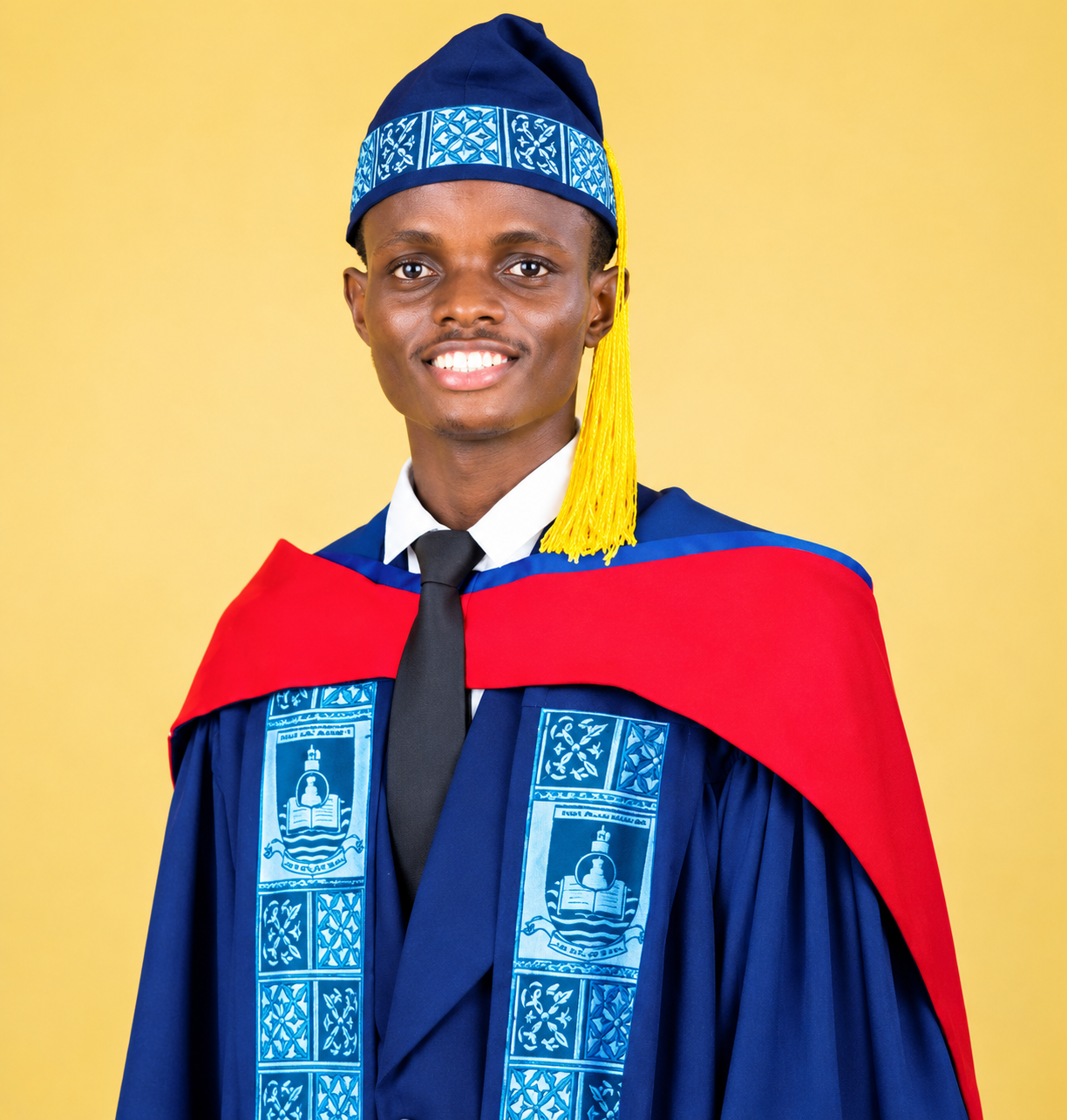



From Struggling to Eat on Campus to Winning ₦10m: How LASU’s Best Graduate Beat Poverty
At a time when many students would have been tempted to abandon their studies because of hunger and financial hardship, 22-year-old Samuel Adebanjo found another way to survive.
He taught.
He taught students preparing for GCE, JAMB and other examinations. He organised paid tutorials, helped with assignments, wrote projects and prepared reports.
The money helped him stay in school.
But something else happened along the way: the young man teaching others was unknowingly preparing himself to become the best student in Lagos State University.
Adebanjo has now graduated with a remarkable 4.97 CGPA out of 5.0, emerging as LASU’s overall best graduating student for the 2025/2026 academic session.
For the feat, the university rewarded him with a staggering ₦10 million.
His story became one of the biggest highlights of LASU’s recent convocation, an event that attracted thousands of graduates, parents and guests and created massive traffic around the university’s Ojo campus.
While his face appeared prominently on posters mounted across the convocation venue, celebrating him as the university’s star graduate, the story behind that face was one of struggle, sacrifice and determination.
Adebanjo came from a family that could not afford to give him everything he needed during his university years.
There were times he struggled to feed himself.
There were times when money from home was simply not enough.
And there were times when he had to choose between his needs and his academic ambitions.
But quitting was never an option.
“I struggled a lot to make ends meet because I didn’t receive much from home,” he recalled in an interview with The PUNCH.
Help came occasionally from his fellowship, church and even his former secondary school, but Adebanjo knew he could not depend entirely on others.
So, while his classmates were attending lectures, studying and preparing for examinations, he was also building a small teaching business around his knowledge.
From 200 level, he began organising paid tutorials and helping other students with their academic work.
What he did not initially realise was that teaching was becoming his secret weapon.
Every time he explained a difficult concept to another person, he understood it better himself.
Every tutorial became another revision session.
Every question from a student forced him to think deeper.
Eventually, the struggle to make money and the desire to help others became part of the strategy that produced his outstanding academic result.
Adebanjo calls it the Feynman Technique — learning by teaching.
“I realised I understood more when I was teaching,” he said.
That method would become particularly useful in Aerospace Engineering, the course he chose because of his fascination with aircraft and everything that flies.
LASU was the only state university in the South-West that he knew of where he could pursue the course as a public university, and when he eventually gained admission, he came in with a clear target: graduate with a first class.
He started strongly.
In his first semester of 100 level, he recorded a 4.81 GPA. Dissatisfied with missing the perfect 5.0, he returned in the second semester and scored 5.0, finishing the year with a 4.90 CGPA.
The academic pressure increased when his set moved from the Ojo campus to Epe for 200 level.
The distance from mainland Lagos worried him, but he turned the disruption into another reason to focus.
By the end of 200 level, his CGPA had risen to 4.94.
But Adebanjo was doing much more than studying.
He became one of the founding members of Space Club LASU, a community built around students’ interest in space, aerospace, rockets, the solar system and related fields.
He served as Learning and Development Coordinator and later became involved in EdTech, teaching international programmes such as GCSE, SAT and A-Level curricula to students outside Nigeria.
He was also active in the Society of Petroleum Engineers, LASU, eventually becoming its Academic Director during his 400 level.
Through all of this, he continued teaching tutorials and helping students in his department.
His philosophy was simple: academic excellence should not prevent him from helping others.
But just when his academic journey appeared to be gathering momentum, another burden hit.
His father became seriously ill.
During his 400 level industrial training, the family discovered that his father had high blood pressure and was struggling to sleep.
Adebanjo’s savings — money he had painstakingly earned and kept for himself — went into his father’s treatment.
The financial pressure became heavier.
There were moments he felt overwhelmed and questioned whether all the sacrifice was worth it.
“I knew that my dad and mum didn’t have enough money. There was practically nothing at home,” he said.
Yet, he refused to surrender.
“I never wanted my background to keep me down.”
That sentence perhaps captures the story of LASU’s latest academic star better than any certificate could.
Adebanjo is the second of three children and the only male child. His parents did not attend university, making him the first university graduate in his family and its first graduate engineer.
He had already shown academic promise before entering LASU.
After finishing secondary school as the best student, he received a scholarship from SS1 through SS3, with his WASSCE and UTME fees also covered.
That success strengthened his belief that education could change his circumstances.
By 400 level, he began to realise that something extraordinary might be possible.
He noticed that his CGPA was approaching the highest figures recorded by students before him. He entered his final year with a CGPA of about 4.96 and set his eyes on the top prize.
He prayed for a 5.0 GPA.
He got it.
With a 5.0 GPA in 500 level, Adebanjo finished with a 4.97 CGPA and emerged as LASU’s overall best graduating student.
When his Head of Department called to break the news, he could hardly believe it.
“Adebanjo, congratulations. You’re the overall best graduating student.”
The words that followed were not just a reward for five years of studying.
They were the payoff for countless nights of reading, teaching, struggling, worrying about money, caring for an ill father and refusing to allow poverty to write the final chapter of his life.
When he told his parents, they were overjoyed.
And then came another surprise: LASU’s ₦10 million reward for its overall best graduate.
The young man who once struggled to feed himself on campus was suddenly standing at the convocation as the university’s highest-performing graduate, with millions of naira attached to his achievement.
His story is therefore bigger than a CGPA.
It is the story of a student who turned hardship into motivation, teaching into a learning strategy and academic excellence into a ladder out of poverty.
Adebanjo came to LASU wanting to become an aerospace engineer.
He left as something even bigger in the eyes of his family and university — a living example that where a young person starts does not have to determine where he ends.
