
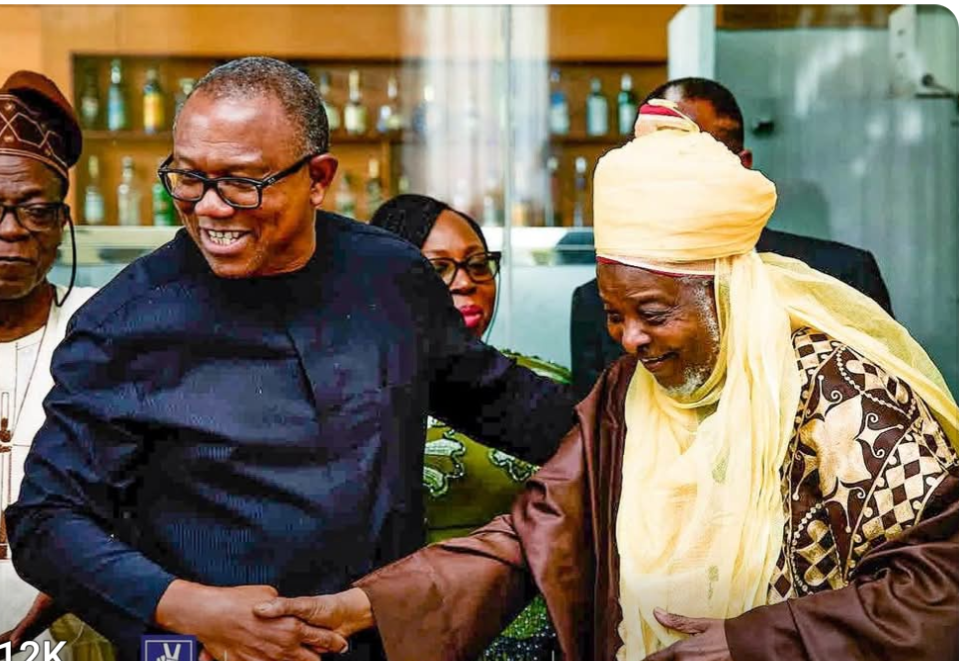



Obi with northern traditional head
A political opinion argues that Peter Obi could build a winning coalition across parts of southern and northern Nigeria, making the 2027 presidential election a defining moment for Igbo political representation.
As political calculations ahead of Nigeria’s 2027 presidential election gather momentum, a renewed debate over ethnic representation, regional alliances and the possibility of an Igbo presidency is placing former Labour Party presidential candidate Peter Obi at the centre of discussions about the country’s political future.
In an open letter addressed to the Igbo people, the writer, identified as Igbo Writer, argues that the South-East must seize what he describes as a golden opportunity to produce Nigeria’s next president rather than continue supporting presidential ambitions from other regions without securing the nation’s highest political office for an Igbo candidate.
The argument rests on the writer’s assessment that Obi could attract support beyond the South-East, including among Christians, young voters, economically frustrated Nigerians and political constituencies dissatisfied with the performance of the current administration.
Although the writer’s projections remain political opinions rather than established electoral forecasts, the letter raises questions about the geographical reach of Obi’s support and the alliances that could determine the outcome of the 2027 election.
South-East Support and the Wider Electoral Map
The writer identifies the South-East as the foundation of a potential Obi presidential coalition, arguing that strong support across the region could provide the starting point for a broader national campaign.
He projects that Obi could secure overwhelming support in the Igbo-speaking states and extend his appeal into parts of the South-South, North-Central and South-West regions.
Among the states highlighted in the letter are Cross River, Akwa Ibom, Edo and Rivers in the South-South; Benue and Plateau in the North-Central; Lagos in the South-West; and Kano in the North-West. The writer also identifies the Federal Capital Territory as a potential source of support.
These projections have not been established by verified polling data in the letter. Actual electoral outcomes would depend on candidate nominations, party structures, voter turnout, regional political alliances, campaign organisation and the issues that matter most to voters.
Nevertheless, the writer’s argument highlights a central question for Obi’s supporters: whether the enthusiasm associated with his political movement can be translated into a geographically diverse coalition capable of competing effectively across Nigeria’s six geopolitical zones.
For the 2027 contest, the distinction between strong regional support and a winning national coalition will be particularly important.
Christian Voters, Youths and the Search for Political Alternatives
Beyond ethnic identity, the letter identifies Christian voters and Nigerians dissatisfied with economic hardship and insecurity as potential constituencies for Obi.
The writer argues that concerns about the cost of living, public safety, unemployment and governance could influence voters across regional and ethnic boundaries.
However, Christian voters do not constitute a politically uniform bloc, just as young Nigerians and people experiencing economic hardship have different priorities and political preferences. Their voting decisions will depend on individual circumstances, candidates’ records, policy proposals and the credibility of competing campaigns.
For Obi, the challenge would be to turn any cross-regional goodwill into a coalition built around clearly communicated policies, credible candidates, effective grassroots mobilisation and a practical response to the country’s economic and security challenges.
Such a coalition would need to demonstrate that its appeal extends beyond regional identity and can accommodate Nigerians with different religious, cultural and political backgrounds.
The North and the Contest for Political Alliances
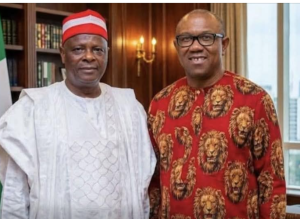
The writer also points to developments in the North as a potential factor in the 2027 presidential race, arguing that dissatisfaction with the current administration could create opportunities for opposition candidates.
He suggests that political alignments involving northern voters, former vice-president Atiku Abubakar and President Bola Tinubu could reshape the electoral landscape.
The letter also refers to reports of anti-government protests in northern states, interpreting them as evidence of possible dissatisfaction with the ruling party.
However, reports of protests or criticism of the government should not automatically be taken as proof that an entire region has rejected a particular candidate. Northern Nigeria comprises diverse political, religious, ethnic and economic constituencies whose preferences cannot be reduced to a single position.
The extent to which dissatisfaction with the federal government translates into support for Obi, Atiku or another opposition candidate will depend on the candidates, their alliances and the issues dominating the campaign.
For Obi’s supporters, the strategic question is whether the political space created by dissatisfaction with the government can be converted into support across constituencies that have historically backed different parties.
Igbo Political Representation and the Question of Inclusion
At the heart of the open letter is a longstanding debate about political inclusion and the opportunity for an Igbo candidate to lead Nigeria.
The writer argues that Igbo politicians and voters have repeatedly played significant roles in national political alliances without the South-East securing the presidency in the Fourth Republic.
He invokes historical figures, including Nigeria’s first president, Nnamdi Azikiwe, and other prominent Igbo leaders, to illustrate what he considers the gap between the contributions of Igbo people to national development and their representation at the highest level of executive power.
The letter also criticises political alignments involving some South-East leaders and the ruling APC, questioning whether cooperation with the federal government serves the region’s long-term political interests.
These arguments reflect the writer’s political position. Support for a particular party or presidential candidate, however, varies among Igbo voters, and the region’s political interests are not necessarily represented by a single party or individual.
The broader issue is whether Nigeria’s political system can provide credible opportunities for candidates from every region to compete for the presidency on the strength of their programmes, records and ability to build national support.
An Igbo presidency, if achieved through a competitive and constitutionally valid election, would mark a significant development in the country’s presidential history. Its significance would ultimately depend not only on the candidate’s ethnic origin but also on the quality of governance delivered to Nigerians.
Can Peter Obi Turn His Support Into a Winning Coalition?
The 2027 election will test whether Obi can convert his existing political recognition into a durable national coalition.
His prospects will depend on several factors, including the political platform on which he contests, the strength of his party’s organisation, the ability to build alliances outside the South-East, the selection of a running mate, campaign resources and the mobilisation of voters across the country.
The positions adopted by governors, traditional institutions, business figures, religious organisations, youth groups and established political networks could also influence the campaign environment. Their public endorsements, however, should not be treated as conclusive evidence of how their wider constituencies will vote.
The writer maintains that a determined show of support for Obi among Igbo voters could encourage Nigerians from other regions to consider his candidacy more seriously.
Whether that strategy succeeds will depend on the strength of the evidence supporting his wider appeal and his campaign’s ability to address the priorities of voters beyond his regional base.
Ultimately, Nigeria’s presidential election will be decided by voters exercising their constitutional rights, not by ethnic arithmetic alone.
A Defining Moment for the South-East?
The open letter concludes with a call for Igbo political unity behind Obi, presenting the 2027 election as an opportunity to challenge what the writer sees as the region’s historical exclusion from the presidency.
Yet the debate extends beyond whether one candidate can win. It also raises questions about national cohesion, equitable political representation and whether Nigerians can build alliances around shared policy priorities rather than ethnic identity alone.
For the South-East, the election presents an opportunity to debate its political strategy, weigh competing candidates and determine how best to pursue its interests within the federation.
For Obi and other presidential aspirants, the challenge is to demonstrate that they can unite a diverse electorate around credible plans for economic recovery, security, infrastructure, education and accountable government.
Whether 2027 becomes the moment an Igbo candidate reaches the presidency remains uncertain. What is clear is that the question of regional inclusion and the search for a broadly acceptable national leader will remain part of the debate as Nigerians prepare for another presidential election.
UKATA NEWS
