
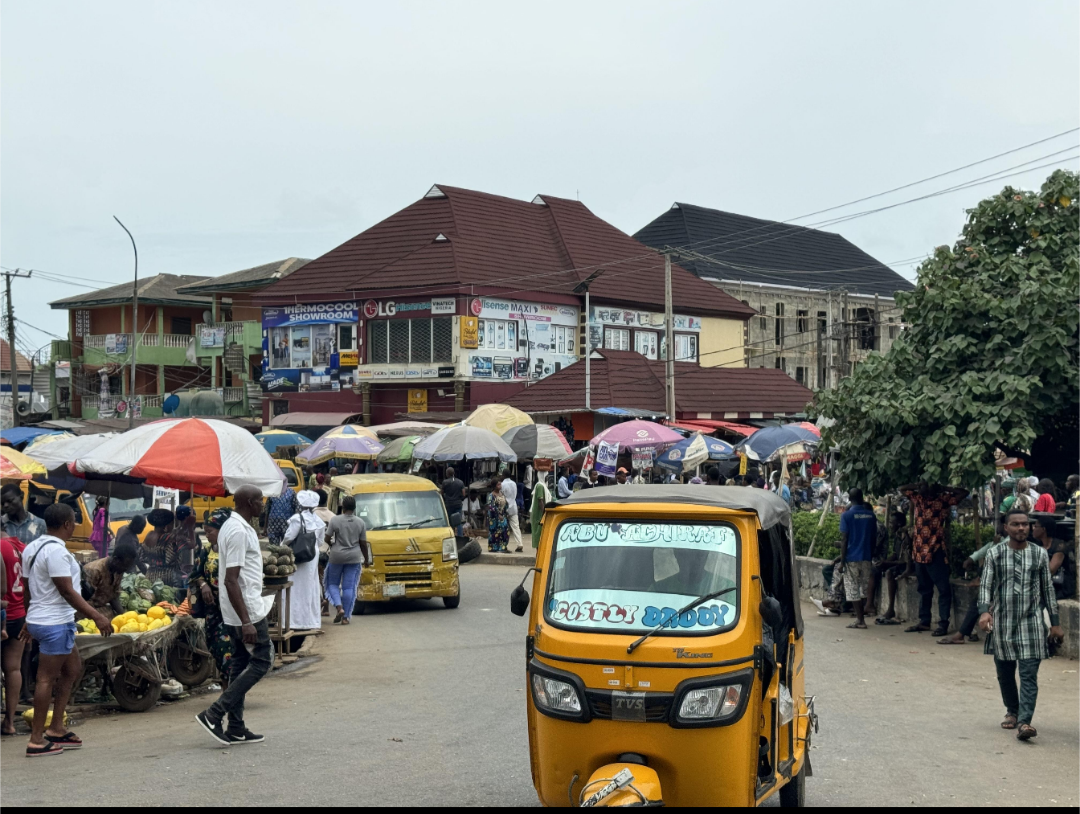

Why Igando Residents Say Their Community Doesn’t Deserve Lagos’ Soaring Rents
“Poor roads, limited business opportunities and high transport costs raise questions over what tenants are really paying for”
For years, Igando served as one of the places in Lagos where workers, young families and low-income earners could escape the crushing cost of accommodation in more expensive parts of the city.
That bargain is now disappearing.
Across the community, residents say rents are rising at a pace that no longer reflects the economic realities of the area, leaving many tenants wondering what exactly they are paying for.
A two-bedroom apartment that once went for about N300,000 or N350,000 a year can now be offered at N800,000 or N900,000, while some two- and three-bedroom apartments reportedly attract annual rents of between N1.5 million and N2 million, depending on location and facilities.
For residents, the problem is not simply that rents are increasing. It is that Igando appears to be importing the rental prices of more commercially developed parts of Lagos without importing the infrastructure, employment opportunities and economic advantages that make those areas attractive.
And that is where the controversy begins.
The Igando Rent Question
Joseph Obi, who moved into Igando in August 2024, said affordability was one of the main reasons he chose the community.
He needed a spacious home for his children and had been told that Igando offered relatively large houses at prices that were still within the reach of ordinary families.
But the relief came with another burden.
“I moved to Igando in August 2024. Coming here was a difficult decision because where I was coming from, Igando was considered a very local place, almost like a village, and a place inhabited mostly by people who could not afford rent in other parts of Lagos.
“But a brother who had just moved there told me the houses were spacious. I needed space for the children, so I decided to come.
“When I came, transportation to my office became a major problem because my transport cost increased about four times. But the water here is good compared with where I was coming from,” he said.
Obi paid about N500,000 annual rent, with his total initial expenditure reaching about N850,000 after agency and agreement fees.
He later watched the same pattern play out around him: tenants leave, houses are renovated and rents are dramatically increased for the next occupants.
“In a year after I came, the landlord asked my neighbour, who was paying N350,000, to leave. After doing some renovation, the apartment was rented for about N1.3 million, including agency and agreement fees. The annual rent is N800,000.
“Within the same street, a tenant paying N300,000 for a two-bedroom flat moved out. The landlady renovated it and rented it out about two months ago for N1.4 million, with the annual rent now N900,000.
“That has become the pattern. A flat that was rented for N500,000 can become N800,000, N900,000 or even N1 million when one tenant leaves and another comes in.”
The figures raise a fundamental question: is the increase being driven by genuine improvements in the value of the community, or simply by landlords benchmarking their properties against increasingly expensive neighbourhoods?
What Has Actually Changed?
There is no doubt that Igando is developing.
Road projects are changing parts of the community, and the construction of a modern Bus Rapid Transit terminal is expected to improve connectivity with places such as Ikeja and potentially reduce transportation costs for residents.
But beyond the major roads, a different Igando emerges.
Many interior streets remain untarred. Drainage infrastructure is inadequate in several areas, and some parts of the community remain poorly planned.
In other words, the community is developing—but not uniformly.
This creates an uncomfortable contradiction for tenants.
They are being asked to pay substantially more for accommodation while still dealing with the same problems that made Igando an affordable alternative in the first place.
For some residents, transportation makes the situation worse.
Theophilus, a resident of Paul Oke Street, Egan-Igando, said the community’s economic base has not expanded sufficiently to justify the rapid escalation in living costs.
“There are no big markets in Igando and that is a problem. Real money is in business.
“If they don’t work as sales boys and girls, many resort to POS businesses or phone charging. Without big markets, people are limited in making money,” he said.
He pointed out that residents often travel to Ikotun, Alaba International Market, Trade Fair, Iyana Ipaja, Egbeda and other commercial centres to conduct business.
“Igando is almost like a road to the big markets. People live here and go to other places for their businesses.
“Workers also travel to Lagos Island, Victoria Island, Ikeja and other places. That costs a lot of money every day.
“So it is insensitive for landlords to increase rents simply because landlords in places like Festac and Alaba are doing the same thing. Those places have major markets and bigger commercial opportunities,” he said.
That argument exposes one of the less discussed aspects of the Lagos housing crisis: rent is only one part of the cost of living.
A tenant paying less rent in Igando may still spend considerably more on transportation if his workplace or business is far away.
When rent rises sharply on top of that transport burden, the supposed affordability of the area disappears.
The People Leaving
The consequences are already being felt by families.
A housewife on Shoga Street said her husband had travelled to the East to secure accommodation for the family because they could no longer cope with the rising cost of living in Lagos.
“My husband has already travelled to the East to secure a house for us. Once everything is ready, I will join him with our children,” she said.
She said several people she knew had already returned to their villages.
“We came here because of the low rent, and now it has become very expensive. Lagos is no longer the Lagos we knew that accommodated the poor,” she said.
Her experience points to a bigger question for Lagos: what happens when the people who keep the city running can no longer afford to live in it?
Teachers, artisans, traders, security guards, cleaners, drivers, junior civil servants and other workers cannot simply disappear because rent has become unaffordable.
If they move farther away, transportation costs rise.
If they remain, they struggle to meet other household needs.
And if they leave Lagos altogether, the city loses part of the workforce that sustains its economy.
When Landlords Become Part of the Competition
Another issue raised by residents is the growing number of landlords operating businesses from their homes.
Ben, a resident around Isuti Road, said many landlords bought land in Igando when the area was still largely undeveloped and built houses as retirement investments.
Some operate fish ponds, poultry farms, vegetable farms, goat-rearing businesses and shops from their compounds.
But residents argue that this can create competition for tenants who depend on small businesses to survive.
At the same time, landlords face their own economic pressures.
A landlady in Egan-Igando, who asked not to be named, said she operates a shop mainly to remain occupied.
“I operate a shop, but it is only to get busy. That is why sometimes I sell below cost price,” she said.
On rent increases, however, she offered an insight into the market pressure confronting property owners.
“We are not the cause. I just try to charge based on what others are charging.
“You wake up one day and you are told that the house in front of yours has been rented for N1 million while yours is still N300,000. Even if you want to maintain the old price, you feel pressure from fellow landlords and even your children,” she said.
Her explanation suggests that the problem may be bigger than individual landlords.
Once one property owner raises the rent, neighbouring landlords gain a new benchmark. The benchmark then spreads from house to house until what was once considered an exceptional rent becomes the new normal.
The Property Boom That May Be Pricing People Out
Real estate consultant and business coach, Dr. Peter Kudaisi, said the surge in property values is also encouraging some landlords to sell their Lagos properties and relocate to cheaper communities in neighbouring states.
He said some property owners can sell houses in Lagos for tens of millions of naira, relocate to places such as Mowe or Ifo in Ogun State, buy cheaper land, build another house and retain a substantial balance.
The attraction is obvious: sell high, rebuild cheaply and pocket the difference.
But there is a consequence for tenants.
When a property is sold at a much higher value, the new owner may increase the rent to recover the investment.
The tenant therefore becomes the final person carrying the cost of the property boom.
And this is where the Igando story becomes more than a story about landlords and tenants.
It becomes a story about who Lagos is being built for.
A Housing Crisis Beyond Igando
Igando is not an isolated case.
Across Lagos, rising property values, construction costs, land prices and demand for accommodation are putting pressure on rents.
But the experience of Igando raises a particularly important issue: should rental prices rise simply because property prices are rising, even where infrastructure and economic opportunities have not kept pace?
There is a legitimate argument for landlords to recover their investment and make reasonable returns.
But there is also a public interest argument that housing must remain accessible to the people who live and work in the city.
The answer cannot be to freeze rents indefinitely or deny property owners the right to benefit from their investments.
Rather, government needs to attack the underlying causes of the housing crisis.
More affordable housing must be built.
Infrastructure must extend beyond major roads into residential communities.
Public transportation must become cheaper and more efficient.
Planning authorities must ensure that new developments come with adequate roads, drainage, water and other basic infrastructure.
There is also a need for stronger implementation of tenancy regulations and greater transparency in the rental market, particularly around arbitrary rent increases and excessive charges.
The Urgency
For the residents of Igando, the warning signs are already visible.
People who came to the community because they could not afford accommodation elsewhere are now contemplating leaving Lagos altogether.
That should concern policymakers.
A city cannot claim to be economically vibrant while the people who clean it, teach in its schools, run its shops, drive its vehicles, provide security and perform countless other essential jobs are gradually being priced out of decent accommodation.
Igando residents are not necessarily asking landlords to give away their properties.
They are asking a more basic question: must every increase in Lagos’ property value automatically become an increase in the cost of survival for the tenant?
The authorities need to confront that question urgently.
Affordable housing is not a luxury. It is central to the quality of life, productivity and stability of any city.
If nothing is done, the rent crisis will continue to push families into overcrowded homes, distant communities and eventually out of Lagos altogether.
And when ordinary people can no longer afford to live in the city where they work, the housing crisis has moved beyond the walls of the rented apartment—it has become a threat to the city’s social and economic future.
By Innocent Onoh

2 comments
Powerful
Very interesting. May God help us here in Lagos