
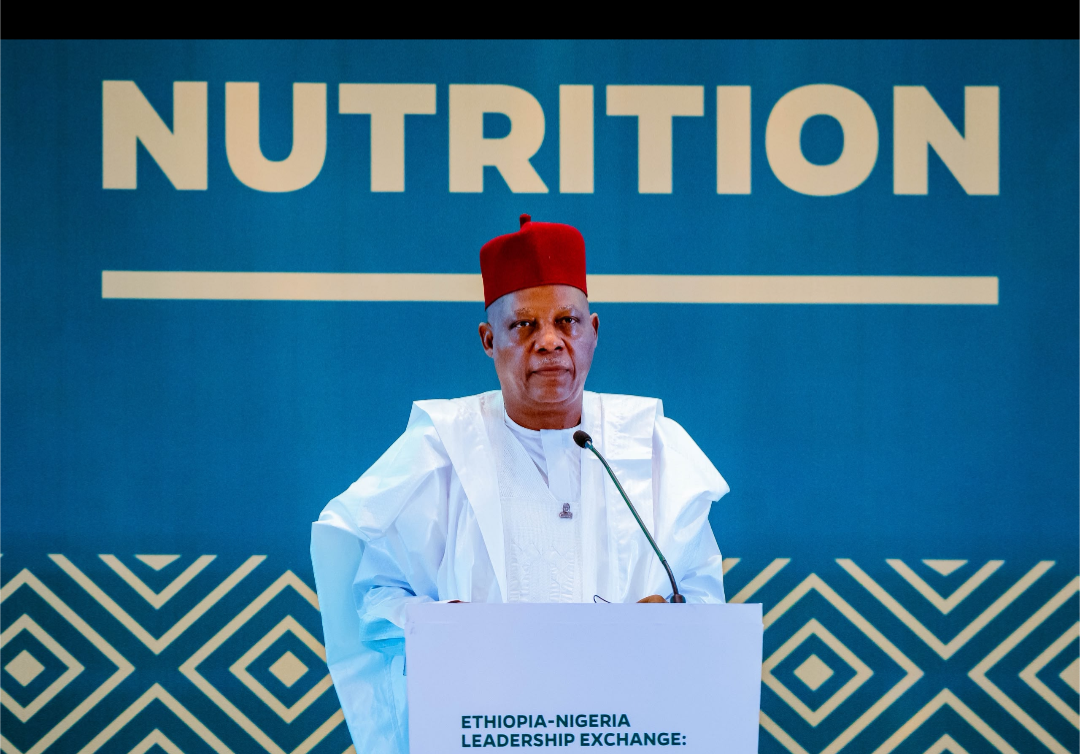



Shettima
Nigeria is moving to strengthen its response to child malnutrition, with Vice President Kashim Shettima announcing plans to accelerate the development of a National Food and Nutrition Bill to protect funding and ensure continuity of nutrition programmes beyond successive administrations.
Shettima made this known on Wednesday at the Nigeria-Ethiopia Nutrition Leadership Exchange Forum in Addis Ababa, Ethiopia, where leaders from both countries discussed strategies for tackling child malnutrition and strengthening nutrition financing.
The Vice President disclosed that Nigeria’s 26-million-dollar commitment to the Child Nutrition Fund had attracted matching support, unlocking a total of 52 million dollars for nutrition interventions.
He also said 21 states had contributed 6.3 million dollars since 2023 towards supplies for the prevention and treatment of malnutrition.
According to Shettima, the proposed legislation would provide stronger backing for the Federal Government’s Nutrition 774 Initiative, while strengthening coordination among the federal, state and local governments in addressing malnutrition at the community level.
He noted that nutrition committees had already been established in 32 State Houses of Assembly and more than 450 local governments, creating an institutional framework that could support stronger legislative action and accountability.
The Vice President also announced plans for a Presidential Nutrition Investment Fund to provide catalytic financing for nutrition interventions, alongside efforts by the Nutrition Financing Subcommittee to mobilise additional domestic resources.
Shettima said the urgency of the intervention was underscored by the level of child malnutrition in the country, noting that about 40 per cent of Nigerian children under five are affected by stunting, with undernutrition estimated to cost the Nigerian economy about 56 billion dollars annually.
Nigeria’s National Policy on Food and Nutrition 2026–2035 targets a reduction in the country’s stunting rate to 32 per cent by 2029, 28 per cent by 2032 and 25 per cent by 2035.
The Vice President said the government was also engaging the private sector to improve the availability and affordability of nutritious food, while working with industry and regulators to strengthen compliance with food fortification requirements.
Earlier, Ethiopia’s Deputy Prime Minister, Temesgen Tiruneh, said sustained political leadership, financing and accountability were critical to addressing malnutrition.
Tiruneh highlighted Ethiopia’s Seqota Declaration, which targets an end to child stunting by 2030, as an example of a long-term, multi-sectoral approach to tackling malnutrition.
On the sidelines of the forum, Shettima and Tiruneh also held bilateral discussions on strengthening cooperation between Nigeria and Ethiopia in areas including trade, investment, food security, aviation and security.
Shettima reaffirmed Nigeria’s commitment to deeper ties with Ethiopia and called for increased intra-African investment under the African Continental Free Trade Area (AfCFTA).
UKATA NEWS
