
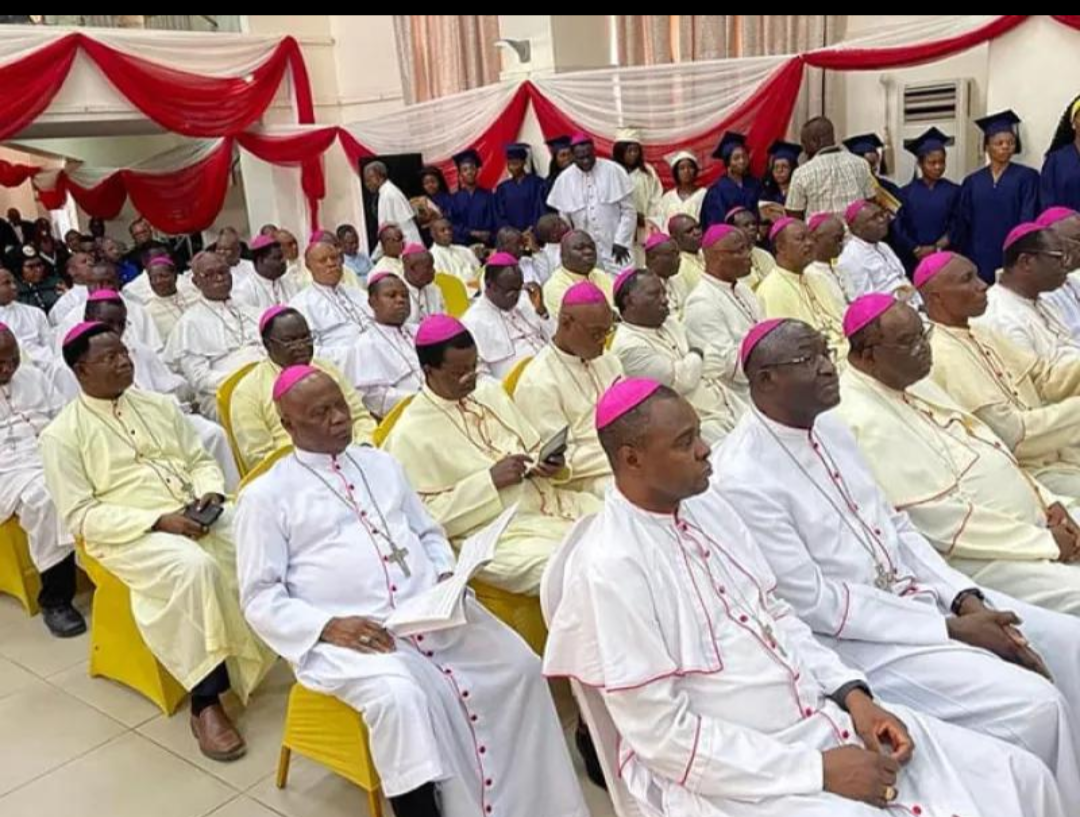



Catholic Bishops Warn of Insecurity, Poverty, Urge Nigerians to Defend Human Dignity Ahead of 2027
The Catholic Bishops Conference of Nigeria (CBCN) has called on the Federal Government, political actors and Nigerians to work together to protect human dignity, tackle insecurity and ease the economic hardship confronting millions of citizens.
They also urged Nigerians to approach the 2027 general elections with a renewed sense of responsibility, calling for free, fair and credible elections and encouraging eligible voters to participate actively in choosing leaders according to their conscience.
The call was contained in a communiqué issued at the end of the CBCN’s Second Plenary Meeting for 2026, held from September 10 to 18 at the Our Lady and St. Kizito Pastoral Centre, Oke-Gada, Ede, in Osogbo Diocese, Osun State.
The communiqué was signed by the President of the Conference, Archbishop Matthew Man-Oso Ndagoso of Kaduna, and the Secretary, Bishop Peter Olukayode Odetoyinbo of Abeokuta.
At the heart of the Bishops’ message was concern over the impact of insecurity, poverty, weak infrastructure and what they described as assaults on human dignity.
“It is, however, regrettable that insecurity, poverty, poor infrastructure, bad governance, and assault on human dignity have continued to ravage our nation and its citizens,” the Bishops stated.
They particularly expressed concern over the continued spread of kidnapping, banditry, violence and illegal mining, warning that these criminal activities were robbing Nigerians of peace and threatening national unity.
The Bishops called on the government to strengthen security forces, improve intelligence gathering and ensure that perpetrators are held accountable.
They also urged authorities to recover communities and vast portions of land occupied by criminal groups and return displaced Nigerians to their ancestral homes.
“We demand Government to do all that is necessary to stop banditry and recover the vast portions of land used for this criminal activity and ensure a productive and beneficial use of the land,” the communiqué said.
The Conference expressed particular concern over attacks on schools and places of worship, as well as the abduction and killing of students and worshippers.
It called for stronger measures to enable millions of internally displaced persons to return home, while urging government at all levels to protect migrants and refugees and guarantee their basic rights.
Beyond insecurity, the Bishops drew attention to the economic pressures facing Nigerian families, warning that poverty was increasingly leaving people struggling to meet basic needs despite the country’s abundant resources.
“We note with grave concern how poverty has been used as a despicable instrument of control in our nation. Hardship and lack of basic needs leave many families struggling to survive despite our national wealth,” they said.
The Bishops called for policies that would create jobs, support local businesses, encourage private-sector participation and reduce the financial burden on poor and vulnerable households.
They also urged Nigerians to embrace honest work, support local enterprises and reject corruption and criminality.
The Conference linked the economic wellbeing of citizens to the availability of basic infrastructure, expressing concern over bad roads, unreliable electricity and failing public utilities.
It called for increased and transparent investment in public infrastructure, including roads, electricity, clean water and railway transportation.
Technology, AI and the 2027 Elections
As Nigeria moves closer to the 2027 general elections, the Bishops also raised concerns about the responsible use of technology and Artificial Intelligence (AI).
While acknowledging the positive potential of technology, they urged politicians and other users to deploy it ethically and responsibly.
“We urge all politicians and others to exercise responsibility and ethics in deploying technology and Artificial Intelligence (AI), especially as we approach the forthcoming elections,” the Bishops stated.
The Conference called on all stakeholders to work towards free, fair and credible elections and urged eligible voters to participate in the electoral process.
It further announced that December 8, 2026 would be observed as a special national day of prayer and fasting for the success of the 2027 elections.
The Bishops also directed dioceses and parishes across the country to embark on civic education, voter mobilisation, end-of-month fasting and Rosary processions from October to December 2026.
Bishops Reject Foreign Aid Bill
The CBCN also criticised the Foreign Aids (Regulation, Transparency and Disclosure) Bill 2026, which has passed first and second readings in the National Assembly.
According to the Bishops, although some of the Bill’s provisions may appear aimed at improving transparency, they could give government officials excessive discretion over churches, mosques, schools and humanitarian organisations receiving foreign assistance.
The Conference therefore urged the National Assembly and Federal Government not to proceed with the Bill, arguing that it could undermine freedom of association, religion, thought and conscience.
“The Bill risks creating an unnecessary layer of bureaucracy, duplicating existing laws, and granting excessive government control that could stifle independent civic space,” the Bishops warned.
Human Dignity at the Centre
The Bishops placed the dignity of the human person at the centre of their communiqué, condemning sexual violence and other forms of abuse and urging the Church and wider society to protect vulnerable people.
They also called for greater use of digital platforms and social media in evangelisation and Christian education, particularly in responding to what they described as the growing influence of neo-paganism among some young people.
On education, the Conference urged governments to meet their constitutional responsibilities by providing quality education, while reaffirming the Catholic Church’s readiness to collaborate with government in strengthening the education sector.
In their concluding message, the Bishops maintained that Nigeria’s challenges, though serious, should not extinguish hope.
“But all hope is not lost. Every positive change at home, at work, or in our community makes the world a better place,” they said.
The CBCN consequently renewed its call for what it described as “a renewed politics” centred on moral principles, protection of human life and dignity, and the pursuit of the common good.
The Bishops also called on Nigerians to reject ethnic and religious divisions, cooperate with security agencies and contribute individually and collectively to building a peaceful and just society.
By Innocent Onoh
