



Africa Risks Losing Its Critical Minerals Advantage Through ‘Divide-and-Deal’ Strategy — MTN Chairman
Africa may be sitting on one of its greatest economic opportunities in generations, but the continent could lose much of the advantage if individual countries continue negotiating critical-minerals deals separately, MTN Group Chairman, Mcebisi Jonas, has warned.
Jonas said Africa’s vast deposits of minerals needed to power the modern global economy give the continent enormous bargaining power — but only if African countries learn to use that strength collectively.
He spoke while addressing Fellows of the fifth cohort of the MTN Media Innovation Programme (MTN MIP), who are currently on a study trip to South Africa.
His message was simple but significant: Africa has what the world needs, but it must learn how to negotiate from a position of strength.
“We have the highest concentration of minerals in the world, particularly critical minerals, and we have a very growing young population,” Jonas said, identifying the continent’s mineral wealth and youthful population as two of its greatest economic advantages.
The warning comes at a time when the global race for critical minerals is intensifying.
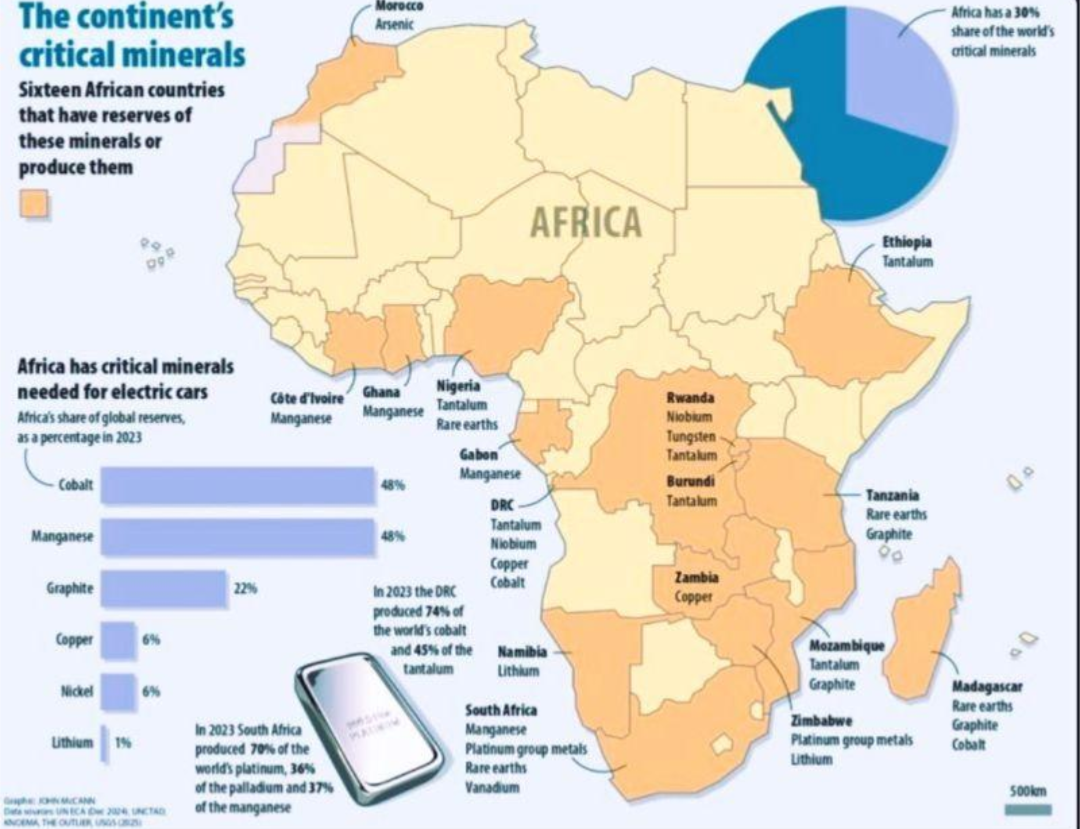
Minerals such as lithium, cobalt, copper, nickel, manganese, graphite and rare earth elements are increasingly important to electric vehicles, batteries, renewable energy technologies, electronics and other industries driving the global energy transition.
Africa has significant deposits of several of these strategic resources.
Countries across the continent are therefore attracting growing interest from major global economies seeking secure access to mineral supplies.
But Jonas believes Africa’s challenge is no longer simply about finding the minerals.
It is about who controls them, who processes them, who benefits from them and what African countries receive in return for granting access to their resources.
He warned that when countries negotiate individually, they risk weakening the continent’s collective bargaining position.
“Negotiating individually could weaken Africa’s influence and bargaining power,” he said.
For a continent that has historically exported large quantities of raw materials while importing finished products at much higher prices, the warning carries particular weight.
Rather than simply extracting minerals and shipping them abroad, Africa needs to use its resource wealth to stimulate local processing, manufacturing, technology transfer, infrastructure development and employment.
This is particularly important given the continent’s rapidly growing population and the millions of young Africans entering the labour market every year.
Jonas said Africa’s collective strength could produce far greater benefits if properly harnessed.
“If we can use that collective strength effectively, it will take us somewhere,” he said.
His position challenges the long-standing pattern of individual countries signing separate mining and investment agreements with foreign companies and governments.
While such agreements can bring investment and infrastructure, the bigger question is whether they collectively translate into sustainable economic transformation for Africans.
For Jonas, Africa’s mineral wealth should therefore be viewed not merely as commodities for export, but as a strategic economic asset that can help the continent negotiate a stronger position in the emerging global economy.
He also linked MTN’s own future to the economic fortunes of the continent, stressing that the company’s success cannot be separated from Africa’s development.
“MTN cannot thrive if Africa doesn’t thrive,” he said.
The message comes at a crucial moment for Africa: the world is coming for its minerals. The question is whether the continent will negotiate as a collection of individual sellers — or as a united economic force capable of turning its natural wealth into industries, jobs and lasting prosperity.
